Which of the Following Is True About Cannabis? Four Options Explained
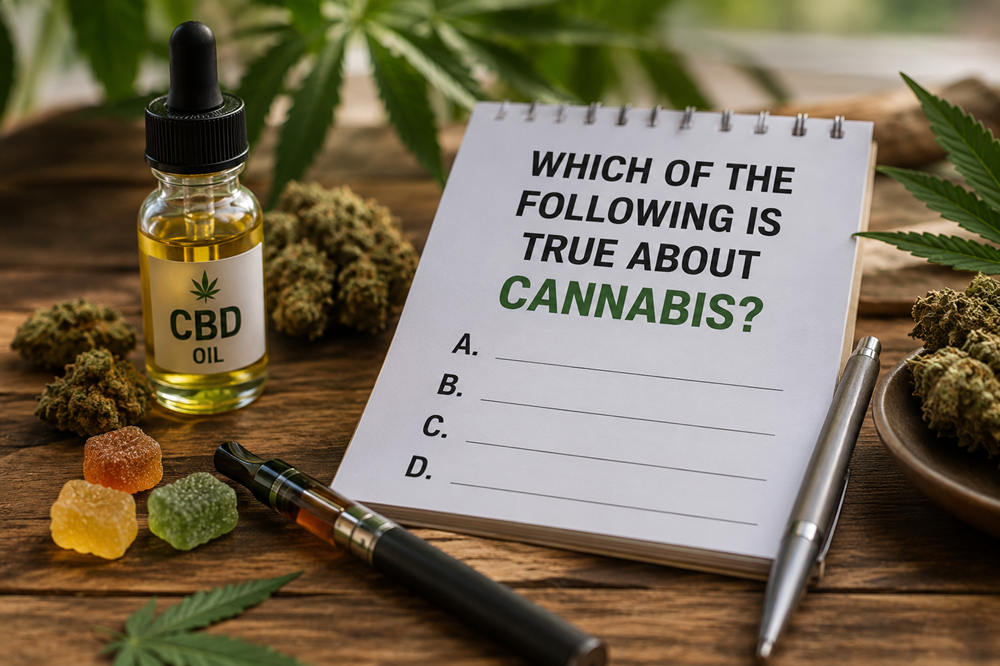
“Which of the following is true about cannabis?” is a common quiz question, but the correct answer depends on the options provided. One frequently used version compares claims about intoxication, vaping, cannabinoids, and changes in THC potency.
Below are the four choices together, followed by an explanation of why each one is accurate, inaccurate, or too broad to support.
The Question and Answer Choices
Which of the following is true about cannabis?
- All cannabis products cause a high.
- Vaping cannabis is safer than vaping nicotine.
- THC-free cannabis products contain no cannabinoids.
- Cannabis samples analyzed in recent decades have contained more THC on average than samples analyzed in the 1990s.
Correct answer: D.
Federal potency monitoring shows that the average delta-9 THC concentration in cannabis samples seized and submitted for testing increased from 3.96% in 1995 to 16.14% in 2022. These figures apply to the samples included in that program, not to every cannabis product currently available.
Option A: All Cannabis Products Cause a High
Verdict: False.
THC, or delta-9-tetrahydrocannabinol, is the principal cannabinoid associated with the intoxicating effects commonly described as a high. However, THC is not the only cannabinoid found in cannabis.
The cannabis plant contains more than 100 identified cannabinoids, including cannabidiol, or CBD. The Centers for Disease Control and Prevention describes THC as impairing or mind-altering, while CBD by itself is not impairing and does not cause a high.
A THC-dominant flower or concentrate may produce intoxication, while a properly formulated CBD product may not. Some topical products are also designed mainly for application to the skin rather than for producing systemic intoxication.
The amount used still matters. A product containing THC may produce little noticeable intoxication at a very small dose and much stronger effects at a larger one. Composition, serving size, and method of use are therefore more informative than the word “cannabis” alone.
Non-intoxicating does not mean risk-free. CBD can cause side effects and may interact with medications. The FDA continues to examine questions about the safety, quality, and composition of commercially available CBD products.
Option A is false because cannabis products do not all contain the same cannabinoids or produce the same effects.
Option B: Vaping Cannabis Is Safer Than Vaping Nicotine
Verdict: Too broad to support.
There is no universal rule establishing that every cannabis vape product is safer than every nicotine vape product. The risks depend on far more than whether a cartridge contains THC or nicotine.
Important variables include:
- The ingredients and additives in the liquid
- The source and manufacturing conditions
- Possible contaminants
- The type and condition of the device
- The temperature at which the product is heated
- The frequency and intensity of use
The outbreak of e-cigarette or vaping product use-associated lung injury, known as EVALI, illustrates why product composition matters. A CDC investigation linked most EVALI cases to THC-containing vaping products, particularly products obtained from informal sources. Vitamin E acetate was strongly associated with the outbreak.
That evidence does not mean every cannabis vape product carries the same risk. It also does not show that nicotine vaping is harmless. Nicotine products involve their own concerns, including addiction and exposure to substances contained in vape aerosols.
A cannabis-versus-nicotine comparison therefore cannot be answered accurately without knowing what products are being compared, how they were made, what they contain, and how they are used.
Option C: THC-Free Cannabis Products Contain No Cannabinoids
Verdict: False.
THC is one cannabinoid within a much larger group of compounds. A product can contain no measurable THC while still containing CBD, CBG, CBN, or other cannabinoids.
Several common product descriptions illustrate the difference:
- CBD isolate: A refined ingredient intended to contain CBD with most other cannabis compounds removed.
- Broad-spectrum extract: An extract that may contain several cannabinoids but is generally processed to remove THC.
- Full-spectrum extract: An extract intended to retain a wider range of naturally occurring compounds and potentially some THC.
These are common marketplace terms rather than guarantees that every manufacturer uses in exactly the same way. A “THC-free” label may mean that THC was not detected above a laboratory’s reporting limit. It does not necessarily establish that absolutely no trace amount is present.
Product labels can also be inaccurate. In a peer-reviewed analysis of 80 unregulated hemp-derived CBD oils, researchers detected delta-9 THC in numerous products even though none disclosed a specific amount of THC on the label.
A certificate of analysis, or COA, may provide more useful information than the front of the package. The report should identify the tested product or batch, the laboratory, the testing date, and the measured cannabinoid concentrations. The batch number on the report should match the number on the product.
Option C is false because removing or not detecting THC does not mean every other cannabinoid has also been removed.
Option D: Cannabis Samples Today Contain More THC on Average Than Samples From Decades Ago
Verdict: True, with qualifications.
The National Institute on Drug Abuse potency data show that the average delta-9 THC concentration in seized cannabis plant samples rose from 3.96% in 1995 to 16.14% in 2022.
That is a substantial increase in the average potency of the samples analyzed. It supports the conclusion that cannabis in the monitored supply became considerably more THC-rich over the period covered by the data.
The finding should not be interpreted to mean that every modern cannabis product is stronger than every product available in the past. The monitoring program examines illegal-market samples seized by the Drug Enforcement Administration and state or local law-enforcement agencies. It is not a complete survey of licensed dispensary products, homegrown cannabis, or every unregulated product.
Modern cannabis also includes several product forms that cannot be compared by looking at flower percentages alone. Concentrates, vape oils, edibles, tinctures, and infused products may report THC in different ways.
Potency Is Not the Same as Dose
Potency describes the concentration of THC in a product. Dose describes how much THC a person actually consumes.
A small amount of a high-potency concentrate could deliver less total THC than a large amount of lower-potency flower. Similarly, an edible label may list milligrams of THC per serving rather than a percentage.
Understanding exposure therefore requires more than reading one potency number. The amount consumed, number of servings, route of administration, and time between doses are also important.
Why Higher Potency Matters
Higher concentrations make it possible to consume a larger amount of THC in a smaller quantity of material. This may increase the likelihood of an unexpectedly intense response, particularly for someone with limited experience or when the serving size is unclear.
NIDA notes that higher THC concentrations have been associated with a greater likelihood of cannabis use progressing to cannabis use disorder, among other health concerns. An association does not mean that every person who uses a high-THC product will develop a disorder, but it is relevant when evaluating the risks of increasingly potent products.
How to Evaluate Similar Cannabis Questions
Other quizzes may use the same opening question with different answer choices. Three checks can help distinguish a supported statement from an oversimplified one.
Identify the Specific Compound or Product
Determine whether the statement concerns THC, CBD, another cannabinoid, cannabis flower, edibles, or vaping products. Evidence about one compound or product form may not apply to all the others.
Watch for Absolute Language
Words such as “all,” “always,” “never,” “completely safe,” and “risk-free” often remove important context. Cannabis products vary in composition, dose, source, and method of use.
Check What the Evidence Actually Measured
Look at the products, doses, population, and period covered by the evidence. For example, data from seized plant samples should not automatically be treated as a measurement of every product in a regulated retail market.
The Bottom Line
For this version of the question, the correct answer is D. Federal monitoring shows that average THC concentration in analyzed seized cannabis samples rose substantially between 1995 and 2022.
The other options are misleading. Cannabis products do not all cause a high, THC is not the only cannabinoid, and vaping risks cannot be reduced to a universal comparison between cannabis and nicotine products.