Día de los Muertos Flowers: Meanings, Traditions, Colors, and Altar Uses Explained
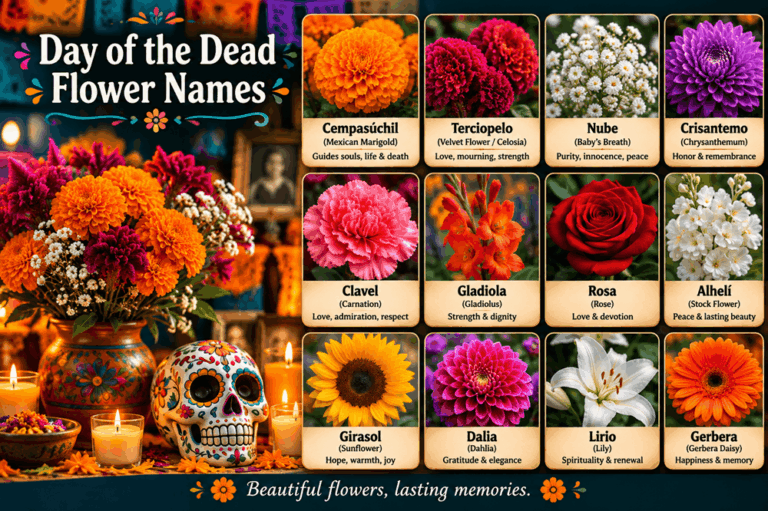
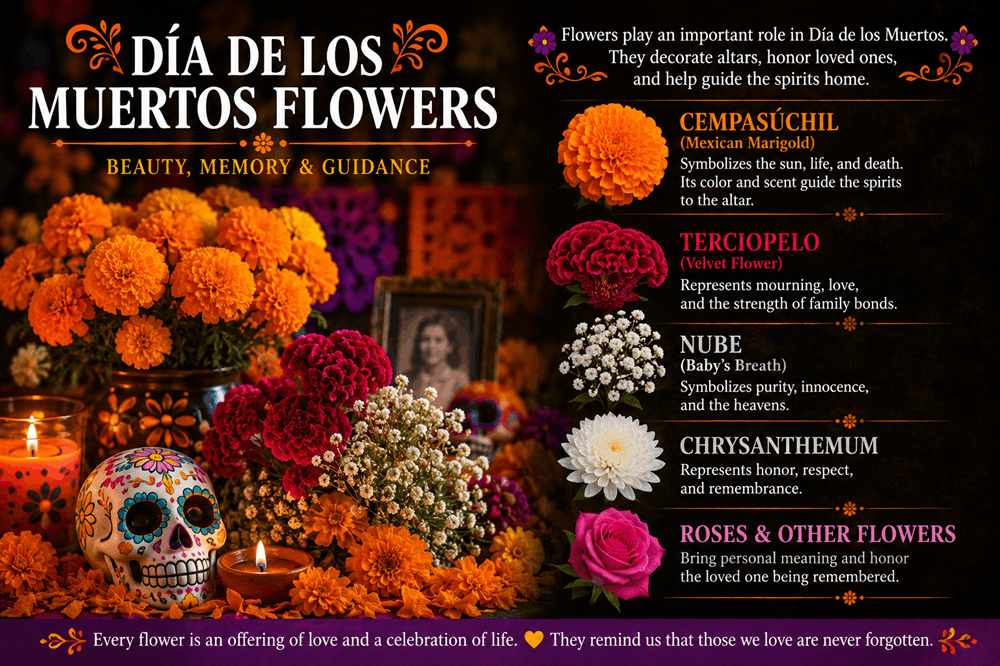
Día de los Muertos flowers honor deceased family members while bringing color, fragrance, and life to altars and graves. The best-known flower is the orange cempasúchil, or Mexican marigold, whose petals are traditionally used to guide returning souls. Other common flowers include red terciopelo, white nube, chrysanthemums, and locally significant blooms chosen for the person being remembered.
Why Are Flowers Used for Día de los Muertos?
Flowers are among the most recognizable elements of Día de los Muertos, but they are more than seasonal decorations. They help transform an ofrenda into a welcoming place where living family members remember and symbolically receive those who have died.
The flowers contribute several things at once:
- Color that makes the altar feel alive and celebratory
- Fragrance that is traditionally said to help guide returning souls
- Petals that can form a path from the entrance to the ofrenda
- Beauty offered as an expression of affection and remembrance
- A visual connection between life, death, nature, and renewal
The National Institute of Anthropology and History’s explanation of Día de Muertos ofrendas notes that flower petals, especially cempasúchil petals, may mark the route from the entrance of a home to the altar. Within the tradition, their vivid color and strong fragrance help the dead find the offerings prepared for them.
Practices vary considerably among Mexican regions, Indigenous communities, families, and households. There is no single flower arrangement that every altar must follow. Some families use elaborate arches and petal paths, while others place one vase beside a photograph.
Cempasúchil: The Most Recognizable Día de los Muertos Flower
Cempasúchil is the flower most closely associated with Día de los Muertos. It is often called the Mexican marigold, Aztec marigold, flor de muerto, or flower of the dead. Its botanical name is commonly given as Tagetes erecta.
The name comes from the Nahuatl word cempohualxochitl, commonly interpreted as “twenty flowers,” “flower of twenty petals,” or “many flowers.” The description reflects the flower’s numerous layered petals rather than a requirement that each flower contain exactly twenty.
According to the Mexican government’s account of the cempasúchil tradition, the flower has long represented both life and death in Mexican culture.
Its golden yellow and orange colors were historically associated with the sun. The flowers appear to hold light within their densely packed petals, making them especially striking on an altar surrounded by candles, photographs, food, and papel picado.
What Does Cempasúchil Symbolize?
Cempasúchil can symbolize:
- The connection between life and death
- The warmth and light of the sun
- Guidance for visiting souls
- Memory and continuing family bonds
- The seasonal return of Día de los Muertos
The flower does not simply represent sadness. Its bright color expresses the idea that remembering the dead can be affectionate, welcoming, and full of life.
Why Are Cempasúchil Petals Used as a Path?
Families may remove the petals and arrange them in a line extending from a doorway, gate, or grave toward the altar. The path may be narrow and simple or designed with crosses, curves, circles, and other patterns.
The tradition holds that the color and fragrance help the souls recognize the route to their families. The Mexican Secretariat of Agriculture’s description of cempasúchil explains that the flower’s strong aroma and sunlike color have long been connected with guiding and honoring the dead.
Petal paths also create a physical expression of welcome. Preparing one requires time and care, turning remembrance into an intentional family activity.
Cempasúchil Arches
Some ofrendas include an arch covered with cempasúchil flowers and greenery. Interpretations differ, but the arch is often understood as an entrance, threshold, or symbolic passage between the world of the living and the world of the dead.
An arch may stand above the entire altar or frame the photograph of the person being remembered. It can be made from natural branches, reeds, wire, or another supportive structure before flowers are attached.
Terciopelo: The Deep Red Flower of the Altar
Terciopelo is another traditional Día de los Muertos flower. Its name means “velvet,” referring to its soft, dense appearance. It is also known as celosía, cresta de gallo, or mano de león, depending on the flower variety and local terminology.
The plant is commonly associated with the genus Celosia. Its blossoms may appear as feathery plumes or folded crests and are available in red, burgundy, purple, pink, yellow, and orange.
Deep red terciopelo is especially noticeable beside orange cempasúchil. The two flowers create a warm, dramatic color combination that has become strongly associated with seasonal markets and altars.
What Does Terciopelo Symbolize?
Terciopelo is frequently interpreted as representing mourning, affection, enduring love, or the blood and vitality of life. These meanings are not rigid rules shared by every family, but they fit the flower’s rich color and traditional ceremonial use.
The flower is also valued for practical reasons. It holds its shape well, adds height and texture to arrangements, and contrasts beautifully with rounded marigold blossoms.
The Mexican Secretariat of Agriculture’s guide to altar flowers identifies terciopelo as one of the important flowers used during the celebration, alongside cempasúchil, nube, and chrysanthemums.
Nube: Delicate White Flowers for Día de los Muertos
Nube, meaning “cloud,” is a name commonly used in Mexico for the tiny white blossoms also known as velo de novia, or bridal veil. The flowers are generally associated with baby’s breath and create a soft, cloudlike appearance around larger flowers.
Nube may be placed in vases, woven into arches, or used to soften arrangements of cempasúchil and terciopelo.
What Does Nube Symbolize?
Its white color and delicate structure are commonly associated with innocence, tenderness, peace, and purity. Nube is often used on altars dedicated to children, traditionally called angelitos, although customs differ among families and regions.
The small flowers are not restricted to children’s altars. They may also be selected because they were loved by the deceased or because their white blossoms balance the intense orange and red colors of other altar flowers.
Chrysanthemums
Chrysanthemums are widely associated with remembrance and funeral traditions in many parts of the world. In Mexico, white, yellow, purple, and other chrysanthemums may appear on graves and Día de los Muertos altars.
The flowers are valued for their large heads, long vase life, and seasonal availability. White chrysanthemums may communicate peace, respect, and grief, while yellow varieties add warmth and blend naturally with cempasúchil.
Chrysanthemums are not as uniquely connected with Día de los Muertos as cempasúchil, but they are an established part of the season in many communities. The Mexican government’s overview of traditional Día de Muertos flowers includes chrysanthemums among the flowers cultivated and used for the observance.
Other Flowers Used for Día de los Muertos
Families may include many other flowers depending on regional traditions, availability, and personal meaning.
White Stock Flowers
Stock flowers, known as alhelí in Spanish, have tall stems and a strong, sweet fragrance. White stock may be added to arrangements associated with peace, remembrance, and departed children.
Historical accounts of modern ofrendas describe some flowers, including nube and alhelí, as contributions that became part of the tradition through cultural exchange during and after the Spanish colonial period.
Sunflowers
Sunflowers are sometimes used for their golden color and strong visual connection to the sun. They can complement cempasúchil or serve as an alternative when marigolds are unavailable.
They may also be included because the deceased loved sunflowers. A personal connection can be more meaningful than following a generalized symbolism chart.
Roses
Roses can express love, respect, grief, gratitude, or devotion. Red roses may honor a spouse or partner, while white roses may be chosen for remembrance or peace.
Roses are not the defining Día de los Muertos flower, but they can make an altar more personal. A favorite flower is an appropriate offering even when it is not traditionally associated with the holiday.
Wildflowers and Local Blooms
Some families use flowers gathered or grown locally. Availability varies across Mexico’s climates and regions, and household practices may reflect local agriculture, Indigenous traditions, family history, and personal preference.
The Smithsonian’s description of Día de los Muertos traditions emphasizes that the observance has substantial regional and individual variation. An altar should not be judged as incorrect merely because its flowers differ from a popular commercial image.
What Do the Flower Colors Mean?
Color meanings are flexible rather than universal. The same color can carry different associations depending on the flower, region, family, and arrangement.
Common interpretations include:
- Orange: sunlight, warmth, guidance, life, and death
- Yellow: light, memory, energy, and celebration
- Red: love, vitality, sacrifice, and strong family bonds
- White: peace, innocence, tenderness, and remembrance
- Purple: mourning, spirituality, dignity, and Catholic observance
- Pink: affection, joy, gratitude, and loving remembrance
These meanings should be treated as helpful interpretations rather than strict instructions. Día de los Muertos is a living cultural tradition, not a standardized system in which every flower color has one officially fixed definition.
How Flowers Are Arranged on an Ofrenda
Flowers can be used throughout an altar rather than being confined to a single vase.
Common arrangements include:
- Vases placed beside the deceased person’s photograph
- Petals scattered around candles and offerings
- A petal path leading from the doorway to the altar
- Garlands hung across the front of the ofrenda
- Flower arches framing the upper level
- Small bouquets placed among food and personal objects
- Flowers arranged directly on a grave
Fresh flowers are often preferred for their fragrance, but paper flowers, fabric flowers, dried arrangements, and reusable decorations may also be used. Artificial flowers can be practical where fresh cempasúchil is unavailable or where an altar must remain displayed for an extended period.
Do You Have to Use Cempasúchil?
No. Cempasúchil is traditional and deeply symbolic, but an altar can still be meaningful without it.
Families living outside Mexico may have difficulty finding fresh Mexican marigolds. They may use locally available marigolds, paper cempasúchil, chrysanthemums, roses, or flowers associated personally with the deceased.
The central purpose of an ofrenda is remembrance. The flowers should support that purpose rather than becoming a test of authenticity or expense.
A simple arrangement chosen with care can be more meaningful than an elaborate display assembled without a connection to the person being honored.
When Are Día de los Muertos Flowers Displayed?
Día de los Muertos observances are commonly centered around November 1 and November 2, although preparations may begin in late October and dates vary among communities.
October 31 and November 1 are often associated with the arrival and remembrance of deceased children, while November 1 and November 2 are commonly connected with deceased adults. These distinctions are not observed identically everywhere.
Families may purchase flowers several days before the main observances, build an altar at home, and take additional flowers to the cemetery. Graves may be cleaned and decorated before relatives gather to remember, eat, pray, tell stories, or spend time together.
Día de los Muertos Is Not Mexican Halloween
The closeness of the dates and the presence of skull imagery sometimes cause Día de los Muertos to be confused with Halloween. They are different observances with distinct histories and purposes.
Día de los Muertos brings together Indigenous practices, Catholic holy days, regional traditions, and evolving family customs. The National Institute of Anthropology and History describes the observance as a cultural and religious synthesis that developed over centuries.
The flowers do not primarily create a frightening atmosphere. They welcome, honor, and remember the dead while affirming that relationships continue through stories, traditions, and family memory.
How to Use Día de los Muertos Flowers Respectfully
Anyone can learn about and appreciate the flowers, but respectful participation requires more than copying a fashionable arrangement.
Begin by understanding the purpose of the ofrenda. It is intended to honor real people, ancestors, or community members—not simply to create a decorative seasonal display.
When creating an altar:
- Include the name or photograph of the person being remembered.
- Choose flowers connected with that person or family tradition.
- Learn the meaning of cempasúchil before using it as decoration.
- Avoid treating sacred or ceremonial elements as costume props.
- Recognize that Mexican traditions differ by region and community.
- Credit the cultural origin when presenting the altar publicly.
Respect also means avoiding claims that one arrangement is the only authentic form. Families have always adapted their ofrendas according to geography, migration, available materials, religious beliefs, and personal memory.
The Bottom Line
Día de los Muertos flowers bring fragrance, color, symbolism, and personal memory to altars and graves. Cempasúchil is the most recognizable flower because its golden color and powerful scent are traditionally believed to guide returning souls.
Terciopelo contributes rich red color and texture, nube adds delicate white blossoms, and chrysanthemums provide fullness and lasting beauty. Roses, sunflowers, wildflowers, and the deceased person’s favorite blooms may also be included.
There is no single required flower arrangement. The most meaningful display is one created with knowledge, care, and a genuine intention to remember the person being honored. Día de los Muertos flowers do not merely decorate death; they express the love, memory, and continuing connections that remain among the living.