What Is THCA Flower? Effects, Potency, Legality, and Quality
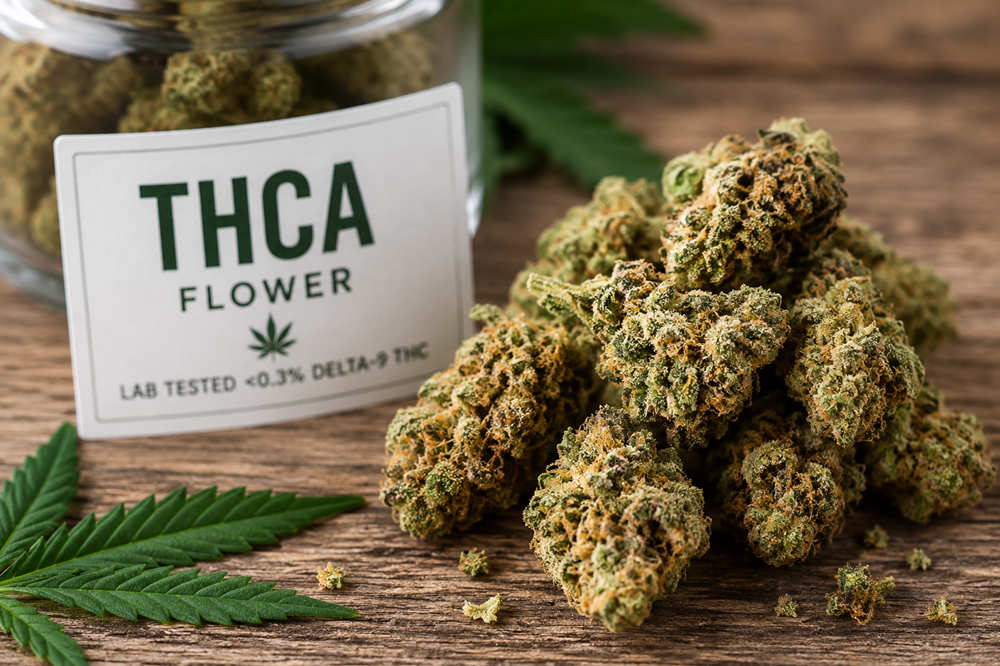
THCA flower is cannabis flower containing a relatively high concentration of tetrahydrocannabinolic acid, or THCA. Although it is often marketed as a hemp product, it can closely resemble flower sold as marijuana in its appearance, aroma, cannabinoid profile, and effects after heating.
The key distinction is chemical rather than visual. THCA is a natural precursor to delta-9 THC. When the flower is smoked, vaporized, or otherwise heated, part of its THCA converts into intoxicating THC.
What Is THCA Flower?
Cannabis plants naturally produce acidic cannabinoids. In THC-dominant varieties, much of the potential THC initially appears as THCA rather than delta-9 THC.
THCA is concentrated in the glandular trichomes covering cannabis flowers and nearby leaves. These resin-producing structures also contain other cannabinoids, terpenes, and plant compounds.
“THCA flower” is therefore not a separate cannabis species or a fundamentally new type of flower. It is usually THC-dominant cannabis described and marketed according to the THCA concentration shown on a laboratory report.
Some products are marketed as hemp under interpretations focused on the delta-9 THC concentration of the finished flower. However, federal crop-production testing already uses a broader calculation that accounts for the flower’s THCA content.
How THCA Becomes Delta-9 THC
THCA contains an additional carboxyl group that distinguishes it from delta-9 THC. Heat removes this group in a chemical reaction called decarboxylation.
This transformation occurs quickly when cannabis is smoked or vaporized. Smaller changes may also take place over time because of light, heat, oxygen, processing, and storage, but heated consumption produces the most relevant conversion.
Because of decarboxylation, a flower sample can contain little measured delta-9 THC before use while still producing a substantial amount of it when heated.
Understanding the 0.877 Conversion Factor
Laboratories commonly estimate the flower’s potential total delta-9 THC with this calculation:
Total delta-9 THC = delta-9 THC + (THCA × 0.877)
The 0.877 factor adjusts for the molecular weight lost when THCA releases carbon dioxide during conversion. The formula is used in USDA hemp-production testing and in established laboratory methods for cannabis analysis.
For example, flower containing 20% THCA has a theoretical contribution of 17.54% delta-9 THC from its THCA before any delta-9 THC already present in the sample is added.
This calculation does not predict the exact amount a person will absorb. Conversion may be incomplete, and cannabinoids can be lost through combustion, vapor, side-stream smoke, handling, and inefficient inhalation.
Does THCA Flower Get You High?
Unheated THCA has not been shown to produce the characteristic intoxication associated with delta-9 THC. That description should not be interpreted to mean that THCA flower remains non-intoxicating when it is used in a way that involves heat.
Smoking or vaporizing the flower converts some of its THCA into delta-9 THC. The resulting THC can affect perception, mood, memory, attention, coordination, reaction time, and judgment.
The intensity of the experience depends on more than the percentage printed on the package. Relevant factors include the amount used, heating method, cannabinoid profile, personal tolerance, individual sensitivity, and whether alcohol or other substances are also involved.
Strain names and labels such as indica, sativa, or hybrid cannot guarantee a specific experience. Different batches sold under the same name may have different chemical profiles.
Is THCA Flower the Same as Marijuana?
THCA flower marketed as hemp may be botanically and chemically similar to flower sold through a licensed marijuana market. Both can come from Cannabis sativa, contain substantial THCA, and produce intoxicating delta-9 THC when heated.
The distinction often depends on legal definitions, testing methods, sampling dates, licensing systems, and the jurisdiction in which the flower is produced or sold.
A person generally cannot determine the legal classification of dried cannabis by examining its color, shape, trichomes, or aroma. The words “hemp” and “THCA flower” on a package are also not conclusive legal evidence.
THCA Flower vs. CBD Flower
THCA flower is generally produced from cannabis selected for higher concentrations of THCA. CBD flower usually contains more cannabidiolic acid, or CBDA.
When heated, CBDA converts into CBD, which does not produce the same characteristic intoxication as delta-9 THC. THCA converts into THC and can therefore result in substantial impairment.
CBD-dominant flower may still contain small amounts of THCA or THC, so it should not automatically be assumed to be free from drug-testing or legal concerns. A batch-specific cannabinoid report provides a more useful comparison than the product name.
How Potent Is THCA Flower?
THCA concentrations vary considerably among products and batches. A percentage on a certificate of analysis represents the concentration found in the laboratory sample, not an exact dose delivered during use.
A report showing 25% THCA means the tested sample contained approximately 250 milligrams of THCA per gram of dry flower. Applying the 0.877 factor produces a theoretical contribution of about 219 milligrams of delta-9 THC per gram before any existing delta-9 THC is included.
Actual exposure is less predictable. It depends on the amount used, conversion efficiency, combustion or vaporization losses, inhalation pattern, and individual absorption.
Flower is also an agricultural material rather than a perfectly uniform manufactured substance. Individual flowers within a batch may vary, especially when harvesting, blending, sampling, and storage are inconsistent.
The THCA percentage is therefore best treated as a general potency indicator rather than a precise forecast of effects.
How to Read a THCA Flower Certificate of Analysis
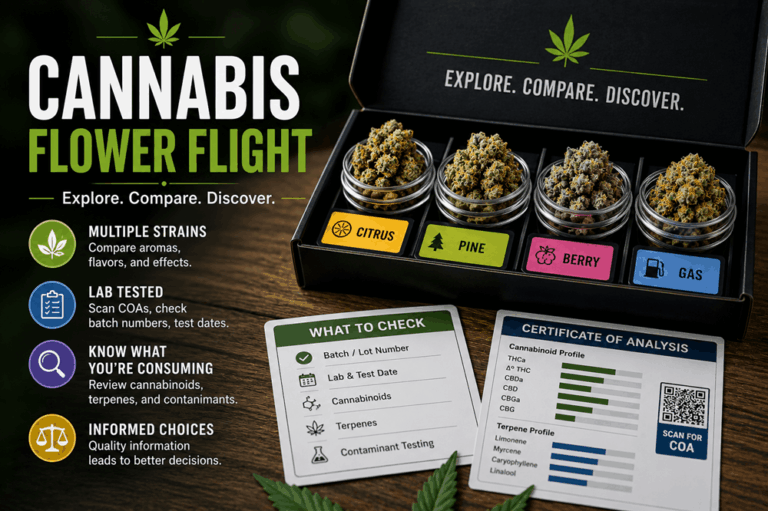
A certificate of analysis, or COA, summarizes the results obtained from a laboratory sample. A useful report should identify the laboratory, product, sample type, testing date, and batch or lot number.
The number on the COA should match the package. A report from another strain, harvest, or production lot does not confirm the contents of the flower being evaluated.
Cannabinoid Results
The cannabinoid panel may list THCA, delta-9 THC, CBDA, CBD, CBGA, CBG, and other compounds. Results are usually expressed as a percentage by weight, milligrams per gram, or both.
One percent by weight is equivalent to approximately 10 milligrams per gram. Flower reported as 18% THCA therefore contains about 180 milligrams of THCA per gram in the sample tested.
Both THCA and delta-9 THC should be considered. Total delta-9 THC provides additional context by estimating how much THC could result from decarboxylation.
Under USDA laboratory guidelines, official hemp-production testing must use a post-decarboxylation or similarly reliable method that accounts for THCA’s potential conversion into THC. Results are reported on a dry-weight basis and include measurement uncertainty.
These tests are generally performed on samples taken before harvest to determine whether a crop meets production requirements. A preharvest compliance result is not necessarily the same as a finished-product COA produced after drying, trimming, storage, and packaging.
Contaminant Testing
A cannabinoid panel measures potency. It does not show whether the flower was tested for mold, pesticides, heavy metals, or other unwanted substances.
A broader flower-testing panel may include:
- Pesticides
- Heavy metals
- Microbial contaminants
- Mycotoxins
- Moisture content
- Water activity
- Foreign material
Testing requirements differ among state cannabis programs and the wider hemp market. In California’s regulated system, for example, every batch must undergo cannabinoid and contaminant testing before sale. A hemp product sold online may not have been tested under comparable rules.
A COA also describes only the sample submitted to the laboratory. It cannot prove that every flower in a package is identical. A passing result applies to the substances tested, the laboratory’s reporting limits, and the standards used by that program.
Warning Signs on a Lab Report
- The batch or lot number is missing or does not match the package.
- The report identifies another product or strain.
- Only cannabinoid potency was tested.
- The laboratory, testing date, or sample details are missing.
- Parts of the report are cropped or obscured.
- The units or total-delta-9-THC calculation are unclear.
- A QR code opens a general company page instead of the specific report.
- The report is unusually old for the batch being sold.
A professional-looking PDF is not automatically authentic. Report numbers, laboratory contact information, and accreditation claims should be independently verifiable when possible.
What Good THCA Flower Should Look and Smell Like
Visual inspection can identify obvious handling or storage problems, but it cannot confirm potency, purity, or legal compliance.
Properly preserved flower often has visible trichomes and an aroma consistent with cannabis, without musty or otherwise unexpected odors. Its texture should not be excessively wet or so dry that it immediately crumbles into powder.
Possible warning signs include:
- White, gray, or fuzzy patches
- Web-like material within the flower
- A musty, mildew-like, or ammonia-like odor
- Unusual moisture or condensation
- Visible insects or foreign debris
- An unexplained perfume-like or chemical smell
Dense trichomes, vivid color, and a strong aroma may make flower look appealing, but none of these features proves that it is potent or free from contamination.
Is THCA Flower Legal?
Legal information reviewed July 22, 2026.
THCA flower occupies a changing legal area in the United States. Federal hemp law, USDA crop-production rules, state controlled-substance laws, and finished-product regulations do not always apply the same standard.
The Current Federal Definition and USDA Testing
As of July 22, 2026, the current federal statutory definition generally describes hemp as cannabis containing no more than 0.3% delta-9 THC on a dry-weight basis.
USDA production rules already require licensed hemp crops to be evaluated using total delta-9 THC:
THCA × 0.877 + delta-9 THC
This testing occurs before harvest. A crop exceeding the acceptable hemp THC level does not comply with federal hemp-production requirements, even when its directly measured delta-9 THC concentration is below 0.3%.
The difference between the statutory wording and the production-testing method has contributed to disputes over finished THCA flower. Sellers may focus on a low delta-9 THC result from the packaged product, while regulators may consider THCA, total THC, licensing, sampling stage, and state law.
The Federal Change Scheduled for November 12, 2026
Section 781 of Public Law 119-37 amended the federal hemp definition. The change was enacted on November 12, 2025, with the relevant provisions scheduled to take effect 365 days later, on November 12, 2026.
The revised definition covers cannabis with no more than 0.3% total tetrahydrocannabinols, including THCA, on a dry-weight basis.
Once the amendment takes effect, flower containing more than 0.3% total tetrahydrocannabinols, including THCA, will not meet the revised federal definition of hemp. This is different from the laboratory phrase “total delta-9 THC,” which applies the 0.877 conversion factor.
Congress, federal agencies, or courts could still affect how the amended law is implemented. Legal information about THCA flower should therefore be dated and reviewed regularly.
State Laws May Be Stricter
States can impose restrictions that go beyond federal hemp law. Depending on the jurisdiction, a state may:
- Use a total-THC standard
- Classify THCA-rich flower as marijuana
- Prohibit or restrict smokable hemp
- Require sales through licensed cannabis businesses
- Set age, packaging, testing, or labeling requirements
- Restrict possession or transportation
A retailer’s willingness to ship to a particular state does not establish that possession or sale is legal there. Current rules should be checked through official state statutes, agriculture departments, health departments, or cannabis regulators.
Why the Package Is Not Legal Proof
Product terms such as “hemp,” “farm-bill compliant,” and “legal THCA” are marketing descriptions rather than binding legal determinations.
The classification of flower can depend on the governing definition, cannabinoid results, testing method, sampling date, production license, distribution channel, and location. Its appearance and odor may also make it difficult to distinguish from regulated marijuana during a law-enforcement encounter.
Can THCA Flower Cause a Positive Drug Test?
Yes. Heating THCA flower produces delta-9 THC, which the body metabolizes into compounds targeted by common cannabis tests.
Drug tests may analyze urine, blood, saliva, or hair. As the National Institute on Drug Abuse explains, tests look for selected drugs or metabolites above a predetermined cutoff rather than identifying the retail source or legal category of a product.
A standard test generally cannot determine whether THC exposure came from marijuana, THCA flower, or another THC-containing cannabis product. Calling the flower hemp does not protect the user from a positive result.
Detection depends on factors including the amount and frequency of use, time since exposure, individual metabolism, specimen type, and test sensitivity. No cannabis product label can guarantee a negative drug test.
Health and Safety Considerations
Once heated, THCA-rich flower presents many of the same concerns as other THC-dominant cannabis flower.
Possible short-term effects include altered perception, anxiety, dizziness, impaired memory, reduced coordination, slower reaction time, and increased heart rate. Responses vary, and products with higher potential THC may be difficult for inexperienced or sensitive users to judge.
Cannabis can impair skills needed for safe driving. It may slow decision-making and reaction time, distort perception, and affect balance and coordination. Alcohol and other impairing substances can intensify these effects, so a person who has used THCA flower should not drive or operate machinery.
Repeated cannabis use can lead to tolerance and cannabis use disorder in some people. Warning signs may include using more than intended, being unable to reduce use, continuing despite problems, or giving up important activities. The risk is associated with more frequent use and may be greater with products that deliver more THC.
Smoking cannabis exposes the lungs to combustion products and can damage lung tissue. Vaporizing avoids smoke from combustion but should not be described as harmless, particularly when the device or product source is uncertain.
Public-health guidance advises avoiding cannabis during pregnancy and breastfeeding. THC can reach a developing fetus and can pass to an infant through breast milk. The health effects of cannabis during pregnancy and breastfeeding remain an active area of research, but potential developmental risks have led public-health agencies to recommend avoidance.
People taking medications or managing cardiovascular, psychiatric, respiratory, or other medical conditions should seek individualized advice from a qualified health professional rather than relying on product descriptions or anecdotes.
All cannabis flower should be kept away from children and pets in a secure, clearly labeled container.
How to Store THCA Flower
Store THCA flower in a sealed, clearly labeled container in a cool, dark, and dry location. Secure it where children, teenagers, pets, and unauthorized adults cannot reach it.
Excessive heat and light can accelerate cannabinoid and terpene degradation. Too much air exposure can dry the flower, while excessive humidity can encourage microbial growth.
Avoid storing it in a hot vehicle, beside a sunny window, or in a humid bathroom. Keep it separate from food, culinary herbs, tobacco, CBD flower, and other materials that could be confused with it.
Flower showing visible mold, webbing, unexplained moisture, or a strongly musty odor should be discarded. Removing only the visibly affected area may not eliminate contamination that has spread through the material.
What to Remember About THCA Flower
THCA flower is THC-dominant cannabis containing much of its potential THC in acidic form. Heating converts part of that THCA into intoxicating delta-9 THC.
A THCA percentage can help compare laboratory samples, but it does not provide an exact dose or guarantee a predictable experience. Product quality also cannot be established through appearance, aroma, strain name, or potency results alone.
A more complete evaluation considers total delta-9 THC, a matching batch-specific COA, contaminant testing, laboratory credibility, physical condition, and secure storage.
Legal status depends on current federal and state rules rather than the wording on the package. With the federal hemp definition scheduled to change on November 12, 2026, legal information should be checked against current official sources before purchasing, possessing, or transporting THCA-rich flower.