Free THCa Flower Samples: What to Check Before You Sign Up
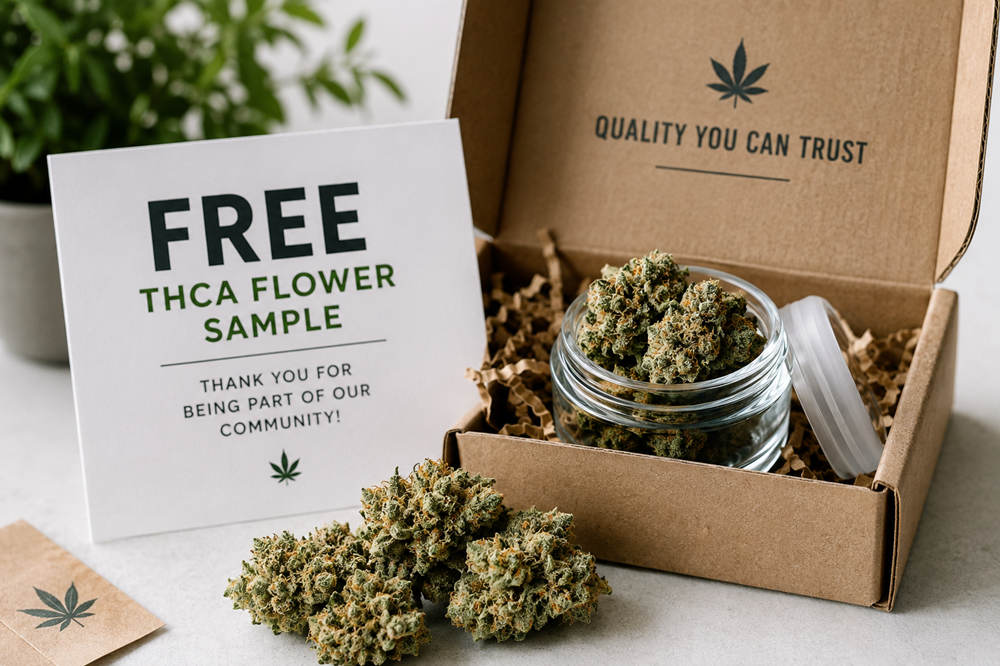
Yes, some companies offer free THCa flower samples, but the flower may be the only part that costs nothing. An offer can still require a shipping payment, card details, age verification, marketing consent, a purchase, or enrollment in recurring deliveries.
THCa flower should also not be assumed to be non-intoxicating. THCa can convert into delta-9 THC when heated, and the resulting effects may impair judgment, coordination, perception, and reaction time.
Before claiming a sample, examine the complete cost, the terms of the promotion, the batch documentation, and the laws that apply at the delivery address.
Are Free THCa Flower Samples Really Free?
A free sample can take several forms. It may be a small amount offered to new customers, an item added to a paid order, a referral reward, a wholesale sample, or a trial connected to a subscription.
Companies may use these offers to introduce a cultivar, collect feedback, build an email list, encourage reviews, or attract future purchases. That does not necessarily make the promotion misleading, but it means the recipient may be exchanging money, personal information, or marketing consent for the flower.
The Federal Trade Commission warns that free trials can lead to unexpected charges when customers do not notice automatic renewals or cancellation deadlines. It also advises consumers to look for preselected boxes and unclear subscription terms.
Before placing an order, check the final total rather than focusing only on the advertised sample price. Shipping, handling, taxes, minimum-purchase requirements, and future payments can make a supposedly free offer considerably more expensive.
What to Check Before Claiming a Sample
A legitimate-looking website does not establish that an offer is transparent or that the flower is properly tested. Review the following points before providing an address, identification document, or payment details.
Read the Full Offer Terms
The page should explain exactly what the sample contains, what must be paid, where it can be shipped, and whether any future obligation begins after the order.
Look specifically for:
- Shipping and handling fees
- Minimum-purchase requirements
- Automatic renewals or recurring shipments
- Cancellation deadlines and procedures
- Refund and return conditions
- Consent to email or text marketing
If these conditions appear only after card details are entered, the offer is difficult to evaluate. Do not assume that the absence of a visible subscription notice means no subscription exists.
Inspect the Checkout Page
Review every item and charge before submitting the order. Make sure extra products have not been added to the cart and look for boxes that are already selected.
A preselected option may authorize future billing, additional shipments, marketing messages, or data sharing. The amount charged now and the amount that may be charged later should both be clearly disclosed.
Verify the Business
Look for a consistent company name, working contact information, a physical business identity, and accessible shipping, privacy, cancellation, and refund policies.
Search the company name with terms such as “complaint,” “billing,” “subscription,” or “scam.” Reviews can reveal recurring problems, although they should not be treated as proof by themselves.
Confirm that the promotion appears on the company’s official website. Some advertisements are operated by affiliate marketers whose primary purpose is generating clicks rather than accurately explaining the offer.
Limit the Personal Information You Provide
An adult-use business may have a legitimate reason to verify age. Before uploading identification, determine who will collect it, how it will be stored, how long it will be retained, and whether it may be shared with another company.
Avoid offers that request unrelated financial information, account passwords, employment details, or identity documents without explaining why they are necessary.
How to Evaluate the Sample’s COA
A Certificate of Analysis, or COA, reports the laboratory findings for a tested sample. It is useful only when the report can be connected to the flower being offered.
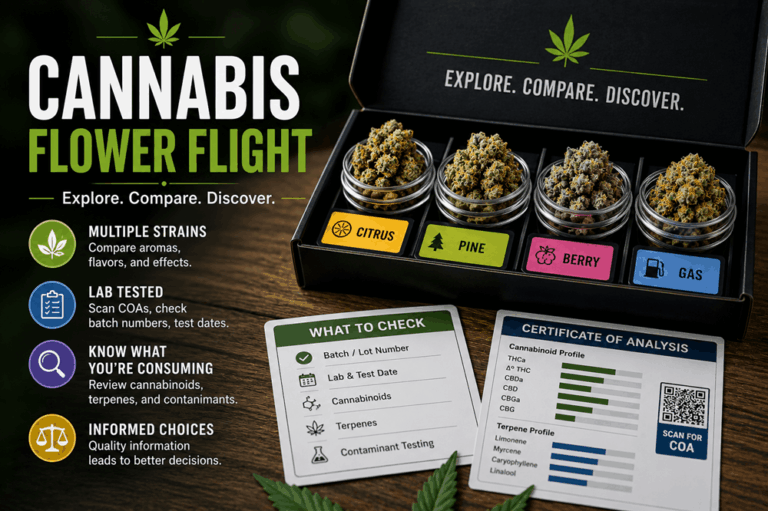
A relevant COA should identify:
- The product and batch or lot number
- The laboratory that performed the analysis
- The date the sample was tested
- The THCa and delta-9 THC results
- The testing method and reporting units
- The contaminant panels that were actually performed
Compare the batch number on the report with the number on the package. A COA from another cultivar, harvest, or lot does not establish the composition of the sample you receive. A QR code that opens a generic testing page is not the same as a batch-specific report.
A cannabinoid panel may show potency without addressing pesticides, heavy metals, microbes, mycotoxins, residual solvents, or other contaminants. The phrase “lab tested” is therefore incomplete unless the company identifies what was tested.
The USDA hemp testing guidelines require official production-compliance tests to consider the potential conversion of THCa into delta-9 THC and report total THC on a dry-weight basis. Those procedures apply to hemp-production lots and should not automatically be confused with a retail quality-control test.
Is It Legal to Receive THCa Flower by Mail?
This legal overview is current as of July 22, 2026. It is general educational information, not legal advice.
A product name, website disclaimer, or “Farm Bill compliant” label does not determine whether a THCa flower sample can legally be delivered to a particular address. Three separate issues matter:
- Whether the product fits the federal hemp definition in effect at the time
- Whether the destination state and locality permit the product
- Whether the sender complies with the carrier’s mailing rules
The Current Federal Definition
As of July 22, 2026, the federal hemp definition generally covers Cannabis sativa L. and its derivatives when their delta-9 THC concentration does not exceed 0.3% on a dry-weight basis.
That definition is scheduled to change on November 12, 2026. Under the amended federal hemp definition, the 0.3% threshold will apply to total tetrahydrocannabinols, expressly including THCa.
The amendment will also exclude final hemp-derived cannabinoid products containing more than 0.4 milligrams of combined total tetrahydrocannabinols per container. Because even a small package of high-THCa flower would likely exceed that amount, many consumer THCa flower samples appear likely to fall outside the amended federal hemp definition once it takes effect. This is an inference from the statutory limits, and the law could change again before November 12, 2026.
State and Local Rules Still Matter
States may regulate hemp-derived flower, total THC, inhalable hemp products, age limits, or online sales more strictly than federal law. A product that fits the current federal definition may still be restricted at its destination.
Check the current rules issued by the relevant state agriculture department, cannabis regulator, health department, or legislature. Do not rely solely on a seller’s shipping map or claim that the product is legal nationwide.
USPS Places Requirements on the Sender
Under USPS Publication 52, qualifying hemp products may be sent through domestic mail only when the mailer complies with applicable federal, state, and local laws.
The sender—not the recipient—must retain laboratory reports, licenses, or other records establishing compliance for at least three years after mailing. USPS prohibits hemp shipments in international mail and in mail addressed to overseas APO, FPO, and DPO locations.
Quality and Safety Considerations
The word “free” does not establish freshness, cultivar identity, accurate potency, proper storage, or contaminant testing. Evaluate a sample using the same standards that would apply to a full-size product.
When it arrives, check whether the package is sealed and whether its product name, batch number, net weight, and laboratory information are consistent with the offer. Avoid using flower with damaged packaging, unexplained moisture, visible foreign material, missing batch information, or documentation that cannot be matched to the product.
A cultivar name does not guarantee a particular potency, aroma, or experience. Growing conditions, harvest timing, storage, processing, and batch variation can all affect the final flower.
THCa flower should not be treated as risk-free because it is marketed as hemp. Heating it can produce THC, and cannabis can slow reaction time, impair coordination, and distort perception. Do not drive or operate machinery after using cannabis.
Cannabis smoke can harm lung tissue and contains many of the same toxins, irritants, and carcinogens found in tobacco smoke. Store the sample securely and out of reach of children and pets.
Be cautious of any promotion claiming that a sample treats pain, insomnia, anxiety, inflammation, or another medical condition. A free offer and a laboratory potency report do not establish that a product is safe or effective as a treatment.
What to Do If You Are Charged Unexpectedly
Save a copy of the offer, the checkout page, the terms, the receipt, and the order confirmation. If the promotion includes a trial period, record the cancellation deadline and keep proof of any cancellation request.
Check bank and card statements for unexpected charges. If a company bills you without your consent or continues billing after cancellation, contact the seller and request a refund. If the issue is not resolved, the FTC advises consumers to dispute the charge promptly with their credit or debit card provider and retain related emails, letters, and notes.
The Bottom Line
Some free THCa flower samples are genuine limited promotions. Others come with shipping fees, data collection, purchase conditions, or recurring charges that are easy to miss.
Before signing up, check the complete cost, read the terms, verify the business, and match the offered flower to a batch-specific COA. Confirm that the product can legally be sent to your location, especially as the federal hemp definition approaches a major change on November 12, 2026.
“Free” describes the advertised price. It does not confirm the flower’s quality, safety, legality, or lack of future obligations.