Deer Resistant Flowers: Twenty Beautiful Choices for Colorful Gardens Deer Often Avoid
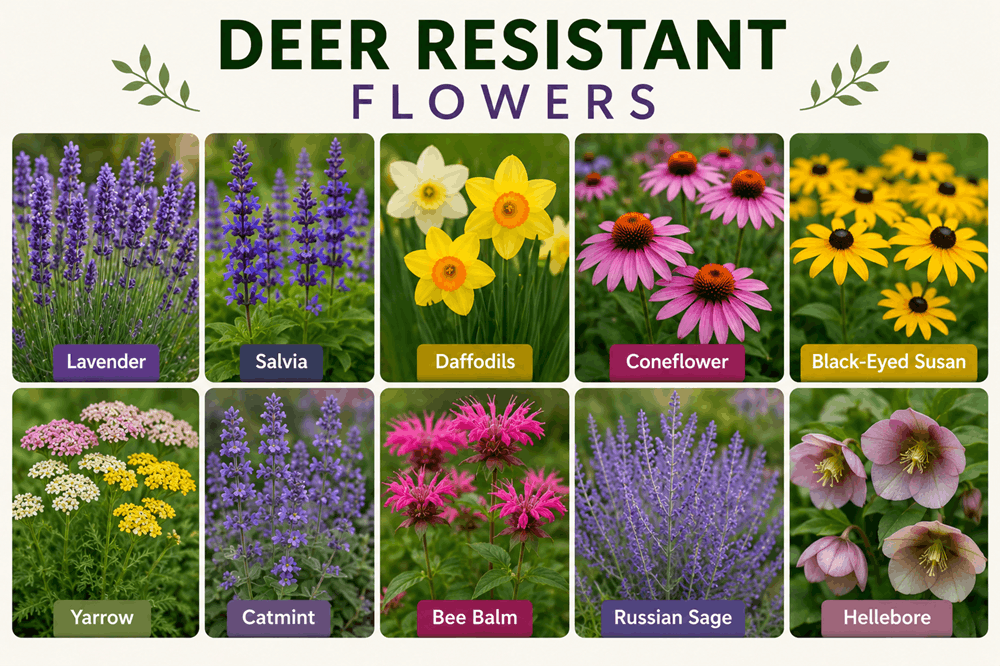
Deer resistant flowers include lavender, salvia, daffodils, marigolds, coneflowers, yarrow, catmint, foxglove, hellebores, bee balm, Russian sage, and several other attractive garden plants. Deer often avoid flowers with strong fragrances, fuzzy or rough foliage, bitter flavors, or toxic compounds. No flower is completely deer-proof, however, because hungry deer may sample almost anything when other food is scarce.
What Does Deer Resistant Actually Mean?
When a plant is described as deer resistant, it generally means deer are less likely to browse it than plants they strongly prefer. It does not mean deer will never touch it. Local deer populations, seasonal food availability, weather, and individual animal behavior can all affect what gets eaten.
Plants tend to have better resistance when they possess characteristics deer find unpleasant, including aromatic foliage, coarse leaves, prickles, bitter compounds, or toxic plant chemicals.
For gardens experiencing heavy deer pressure, resistant flowers work best as one part of a larger strategy that can also include fencing, repellents, physical barriers, and thoughtful placement.
1. Lavender
Lavender is one of the classic choices for a garden where deer regularly wander. Its strongly aromatic foliage and flowers are usually much less appealing to deer than soft, mildly flavored plants.
The slender flower spikes may be purple, violet, pink, or white and are highly attractive to bees and other pollinating insects.
Lavender prefers full sun and sharply drained soil. It generally performs poorly when planted in heavy, constantly wet ground.
Its combination of fragrance, silvery foliage, drought tolerance, and long-lasting flowers makes lavender especially useful along paths, patios, and sunny borders.
2. Salvia
Perennial salvia produces upright flower spikes in blue, purple, pink, white, or violet. Many varieties have strongly aromatic foliage that deer tend to avoid. Illinois Extension lists perennial salvia as reportedly resistant to both deer and rabbits.
Salvias generally prefer full sun and soil with good drainage. Removing faded flower spikes can encourage another flush of blooms.
They are also excellent pollinator plants. Bees regularly visit blue and purple varieties, while tubular red-flowered salvias are particularly attractive to hummingbirds.
3. Daffodils
Daffodils are among the easiest spring bulbs to use in deer-prone landscapes. Their yellow, white, orange, cream, and peach flowers appear when many gardens are just beginning to wake after winter.
Unlike tulips, which deer may eagerly browse, daffodils contain toxic compounds that make them a much less desirable food source.
Plant bulbs during fall in sunny or lightly shaded locations with good drainage. Once established, many daffodils multiply gradually and return for years.
Allow the leaves to die back naturally after flowering so the bulbs can store energy for the next season.
4. Coneflower
Coneflowers, particularly purple coneflower, are dependable summer perennials with raised central cones surrounded by colorful petals. Illinois Extension describes purple coneflower as reportedly deer resistant.
Traditional forms bloom in pinkish purple, while newer varieties include white, yellow, orange, coral, red, and green.
Coneflowers prefer full sun and well-drained soil and become fairly drought tolerant after establishment.
They also support wildlife. Bees and butterflies visit the flowers, while birds may feed from mature seed heads later in the year.
5. Yarrow
Yarrow produces flat clusters of tiny flowers above aromatic, fern-like foliage. Garden varieties may be white, yellow, pink, peach, orange, red, or cream.
The plant thrives in sunny locations and tolerates heat, drought, and relatively poor soil once established.
Its strong-smelling foliage contributes to its usefulness in deer-resistant plantings. Yarrow also attracts beneficial insects and works naturally in cottage gardens, meadow plantings, and informal borders.
Cutting faded stems back can encourage additional flowering.
6. Catmint
Catmint creates soft mounds of gray-green aromatic foliage covered with lavender-blue flowers.
The first bloom can be extremely heavy in late spring or early summer. Cutting the plant back after that display often encourages another round of flowers.
Its fragrant foliage helps make catmint less attractive to browsing deer, while bees regularly visit its flowers.
Catmint prefers full sun and good drainage and becomes drought tolerant after its root system is established.
7. Bee Balm
Bee balm produces unusual clusters of tubular flowers in red, pink, purple, lavender, or white. The foliage has a noticeable aromatic scent, which can help discourage deer.
The flowers are particularly valuable to pollinators. Bees, butterflies, and hummingbirds may all visit a flowering patch.
Bee balm prefers sunlight and consistent moisture. Good airflow is helpful because crowded plants may develop powdery mildew.
The plant gradually spreads through underground growth, making it useful in informal pollinator beds where a larger colony is welcome.
8. Russian Sage
Russian sage produces airy lavender-blue flowers above silver-gray aromatic foliage. A mature planting can create a soft haze of color through summer.
It thrives in full sun, heat, and relatively dry conditions. Rich, constantly wet soil is generally less suitable.
The strong aroma of its leaves makes Russian sage a useful choice in landscapes where deer pressure is a concern.
It looks particularly attractive alongside ornamental grasses, coneflowers, black-eyed Susans, and roses.
9. Hellebore
Hellebores are valuable because they bloom extremely early, sometimes while winter weather is still lingering. Flowers can be white, cream, pink, green, purple, burgundy, or spotted.
Illinois Extension lists Lenten rose, a popular type of hellebore, as reportedly resistant to deer and rabbits.
Hellebores prefer partial shade and rich soil with reliable drainage. They work beautifully beneath deciduous trees and shrubs.
The plants contain toxic compounds and should not be eaten by people or pets.
10. Bleeding Heart
Bleeding heart produces arching stems lined with distinctive heart-shaped pink or white flowers.
It is particularly useful for shaded gardens, where many deer-resistant sun-loving flowers cannot grow successfully. Illinois Extension describes old-fashioned bleeding heart as reportedly deer resistant.
The plant prefers cool woodland conditions with moist, well-drained soil.
In hot climates, bleeding heart may disappear during summer after completing its spring growth. This dormancy is normal rather than a sign that the plant has died.
11. Dianthus
Dianthus includes carnations, garden pinks, and several compact flowering perennials. Many have narrow blue-green foliage and flowers with a noticeable spicy or clove-like fragrance.
Colors include white, pink, red, purple, magenta, and numerous bicolored combinations.
Illinois Extension lists maiden pink dianthus as reportedly deer resistant.
Dianthus generally grows best in full sun and well-drained soil. Compact varieties are excellent for rock gardens, containers, border edges, and paths.
12. Liatris
Liatris, also called blazing star or gayfeather, produces tall purple, lavender, pink, or white flower spikes.
The flowers are unusual because they generally begin opening near the top of the spike and progress downward.
Penn State Extension identifies blazing star as deer resistant, and Illinois Extension similarly lists spike gayfeather as reportedly deer resistant.
Liatris prefers full sun and reasonably well-drained soil. Its flowers are particularly attractive to butterflies and bees.
13. Black-Eyed Susan
Black-eyed Susans bring strong summer color with golden petals surrounding dark central cones.
They tolerate heat, ordinary soil, and periods of dryness once established. Illinois Extension describes them as long-blooming perennials that are reportedly deer resistant.
Plant them in full sun for the strongest flowering.
The flowers attract pollinators, while mature seed heads can provide food for birds if they are left standing toward the end of the season.
14. Blanket Flower
Blanket flower, or Gaillardia, produces colorful daisy-like blooms in yellow, orange, red, and burgundy combinations.
It performs especially well in hot, sunny locations with well-drained soil. Illinois Extension lists blanket flower as reportedly deer resistant.
The plant’s drought tolerance makes it useful in xeriscapes, prairie gardens, and other low-water landscapes.
Regularly removing faded flowers can extend the display, although some seed heads can be left for wildlife.
15. Blue Wild Indigo
Blue wild indigo, or Baptisia, produces upright spikes of purple-blue flowers above attractive blue-green foliage.
It develops into a substantial perennial and can remain in the same location for many years once established.
Illinois Extension lists blue wild indigo as reportedly resistant to deer and rabbits.
The plant prefers full sun and good drainage. Its deep root system makes mature plants drought tolerant but also means they do not appreciate frequent transplanting.
16. Eastern Bluestar
Eastern bluestar produces clusters of pale blue star-shaped flowers in spring, followed by attractive narrow foliage that may turn golden in fall.
Penn State Extension notes that the plant resists deer browsing because of toxic latex in its foliage.
It grows well in sun or partial shade and tolerates a range of garden conditions once established.
The soft blue flowers combine beautifully with yellow spring blooms and darker purple perennials.
17. Beardtongue
Beardtongue, or Penstemon, produces upright stems covered with tubular flowers in pink, purple, red, blue, or white.
Penn State Extension identifies beardtongue as deer resistant.
Many varieties prefer full sun and soil with good drainage. Native species can be particularly useful in pollinator gardens because their tubular blooms provide nectar for bees and hummingbirds.
Choose a species adapted to your region for the easiest long-term care.
18. New England Aster
New England aster produces masses of purple, violet, pink, or occasionally white flowers during late summer and fall.
Penn State Extension lists it as resistant to deer browse.
The late bloom period makes asters especially valuable because they provide garden color and pollinator food after many midsummer flowers have finished.
They prefer full sun and moderately moist soil and can grow quite tall if they are not trimmed earlier in the season.
19. Turtlehead
Turtlehead produces spikes of unusual pink or white flowers whose shape resembles a turtle’s head.
It is particularly useful in gardens with moist soil, where drought-loving plants such as lavender or Russian sage would struggle.
Penn State Extension identifies pink turtlehead as resistant to both deer and rabbits.
The plant tolerates partial shade and works beautifully in rain gardens, pond edges, and moisture-retentive perennial borders.
20. Golden Alexander
Golden Alexander produces flat clusters of small bright yellow flowers in late spring.
Penn State Extension describes it as deer resistant and notes its value as a host plant for black swallowtail butterfly caterpillars.
It works particularly well in native gardens, rain gardens, and naturalistic perennial beds.
The yellow flowers pair naturally with purple-blue plants such as salvia, catmint, and blue wild indigo.
Best Deer Resistant Flowers for Full Sun
For a sunny garden, some of the strongest choices include lavender, salvia, coneflower, yarrow, Russian sage, catmint, black-eyed Susan, blanket flower, liatris, and blue wild indigo.
Many of these plants also tolerate dry conditions once established, making them useful in low-maintenance landscapes.
Full sun generally means at least six hours of direct sunlight per day. Plants receiving substantially less may survive but flower less heavily.
Best Deer Resistant Flowers for Shade
Deer resistance can be more challenging in shade because many traditional shade plants have the tender leaves deer enjoy.
Useful choices include:
- Hellebore
- Bleeding heart
- Some violets
- Turtlehead in moist partial shade
- Shade-tolerant aromatic herbs and ground covers
Penn State Extension also identifies native violets as deer-resistant perennial plants.
Deer Resistant Flowers for Wet Soil
If the garden stays damp, consider turtlehead, New England aster, eastern bluestar, blazing star in suitable soils, and moisture-loving native plants.
Marsh marigold is another option for genuinely wet locations and is listed by Penn State Extension as deer resistant.
Do not try to solve deer problems by planting drought-tolerant flowers in unsuitable wet soil. A deer-resistant plant still needs the right growing conditions to remain healthy.
Flowers Deer Often Like to Eat
Knowing what deer prefer can be as useful as choosing resistant plants. Tender plants with soft foliage and juicy flower buds can be particularly vulnerable.
Daylilies, for example, are noted by the University of Georgia as plants whose flowers and buds deer may prefer.
Hostas, tulips, and some other soft-leaved ornamentals can also become frequent targets in gardens with active deer populations.
If you still want to grow favorite vulnerable plants, place them closer to the house, behind fencing, or among less appealing aromatic plants.
Use Deer Resistant Flowers as a Garden Buffer
One practical strategy is to place less appealing plants along the outer edge of the garden.
Lavender, catmint, salvia, Russian sage, and aromatic herbs can form a fragrant border around more vulnerable flowers.
This will not create an invisible fence, and determined deer can simply walk through it. However, combining resistant plants with barriers and repellents can make browsing less convenient. Extension guidance recommends using multiple methods rather than expecting plant selection alone to solve severe deer problems.
Do Deer Resistant Plants Need Repellent?
Sometimes. In areas with a large deer population, newly planted flowers may still be sampled before deer learn that they dislike them.
Repellents can be especially useful during the first growing season or around valuable young plants.
Rain, irrigation, and new plant growth can reduce the effectiveness of some repellents, so products may need to be reapplied according to their directions.
Physical protection is generally more dependable where deer pressure is severe.
No Flower Is Completely Deer-Proof
This is the most important thing to remember when designing a deer-resistant garden. Even plants that are normally ignored may be eaten when deer are hungry enough.
The University of Minnesota notes that deer may browse almost any plant during periods of nutritional stress, while the University of Georgia similarly emphasizes that no ornamental plant can be considered completely deer resistant.
Think of deer resistance as a scale rather than a guarantee.
The Bottom Line
Some of the best deer resistant flowers include lavender, salvia, daffodils, coneflowers, yarrow, catmint, bee balm, Russian sage, hellebores, bleeding hearts, dianthus, liatris, black-eyed Susans, blanket flowers, blue wild indigo, eastern bluestar, beardtongue, New England asters, turtlehead, and golden Alexander.
For sunny, dry gardens, lavender, Russian sage, salvia, catmint, blanket flower, and yarrow are especially practical choices. Hellebores and bleeding hearts provide options for shade, while turtlehead can bring deer-resistant color to moist areas.
No plant is completely immune to browsing. Deer may eat normally resistant flowers when populations are high or food is scarce. The most dependable approach is to combine less appealing plants with smart placement, barriers, and other protection where necessary. A garden built around flowers deer usually avoid will not guarantee that every leaf remains untouched, but it can dramatically improve your chances of maintaining a colorful landscape without constantly replacing eaten plants.