Flowers That Start With R: Twenty-Five Beautiful Blooms for Gardens and Bouquets
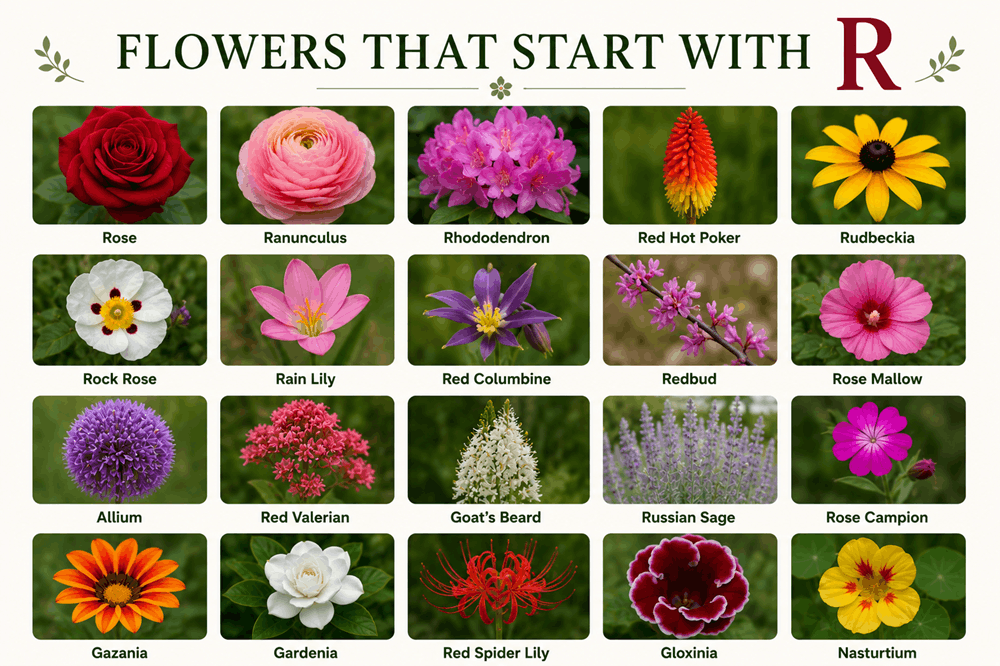
Flowers that start with R include roses, ranunculus, rhododendrons, red hot pokers, rock roses, rudbeckia, and many other beautiful blooms. Some are familiar garden classics, while others grow as wildflowers, flowering shrubs, bulbs, vines, or unusual perennials. This guide introduces 25 flowers beginning with R, along with their appearance, growing habits, symbolism, and practical uses in gardens, containers, pollinator plantings, and bouquets.
1. Rose
Roses are easily the most famous flowers beginning with R. Thousands of cultivated varieties exist, ranging from compact miniature roses to climbing roses, sprawling shrub roses, and large hybrid tea plants.
Flower colors include white, cream, yellow, peach, orange, pink, red, lavender, burgundy, and many multicolored combinations. Some varieties have a strong traditional rose fragrance, while others have fruity, spicy, tea-like, or almost no noticeable scent.
Most roses flower best with plenty of sunlight, fertile soil, good drainage, and consistent moisture. Good airflow around the leaves can also help reduce fungal problems.
Roses have extensive symbolism. Red traditionally represents romantic love, pink can suggest admiration or gratitude, yellow often represents friendship, and white is associated with purity and remembrance.
2. Ranunculus
Ranunculus produces beautifully layered flowers that resemble small roses or peonies. Each bloom can contain dozens of thin petals arranged in tight circles.
Colors include white, cream, yellow, orange, peach, coral, pink, red, burgundy, and purple.
Persian buttercups are among the most popular ranunculus varieties for gardens and cut-flower production. They perform best during cool weather and generally decline once intense summer heat arrives.
Ranunculus is particularly popular in wedding bouquets because of its elegant shape and broad color range.
3. Rhododendron
Rhododendrons are flowering shrubs that produce generous clusters of trumpet-shaped or bell-like blooms. Colors include white, pink, red, purple, lavender, yellow, and orange.
Many varieties are evergreen, providing year-round foliage in addition to their spring flowers.
Rhododendrons prefer acidic, well-drained soil and generally perform well in partial shade. Their shallow roots can suffer when soil becomes compacted or excessively dry.
All parts of rhododendrons can be toxic when eaten, so they should be planted carefully around pets and livestock.
4. Rudbeckia
Rudbeckia includes the familiar black-eyed Susan. Its flowers generally have bright yellow or golden petals surrounding dark brown or black central cones.
Some cultivated forms also display orange, bronze, burgundy, or reddish markings.
Rudbeckia thrives in sunny locations and tolerates ordinary garden soil once established. Many varieties flower from summer into fall and attract bees, butterflies, and other insects.
Seed heads can be left standing after flowering to provide food for birds and winter structure in the garden.
5. Red Hot Poker
Red hot poker, botanically known as Kniphofia, produces striking upright flower spikes covered with narrow tubular blooms.
The classic varieties transition from red at the top through orange to yellow near the bottom, creating the appearance of a glowing torch. Modern forms may also be coral, cream, green, pink, or nearly solid yellow.
Red hot pokers prefer full sun and well-drained soil. Their tubular flowers are particularly attractive to hummingbirds.
The plants develop clumps of narrow, grass-like foliage that provide texture even when flowering has finished.
6. Rock Rose
Rock rose is a name commonly used for Cistus and several other sun-loving flowering plants. Cistus shrubs produce open, papery flowers in white, pink, or purple, often with darker spots near the center.
Individual flowers may last only a day, but established plants produce many blooms during their flowering season.
Rock roses thrive in hot, dry climates and generally perform poorly in heavy, waterlogged soil.
Their drought tolerance makes them useful in Mediterranean-style landscapes, gravel gardens, and sunny slopes.
7. Rain Lily
Rain lilies produce delicate crocus-like flowers that often appear shortly after rainfall. Their sudden blooming habit gives them their common name.
Flowers may be pink, white, yellow, lavender, or peach depending on the species and variety.
The plants grow from small bulbs and form clumps of narrow grassy foliage. They work well along pathways, at the front of flower beds, and in containers.
Rain lilies prefer good drainage and plenty of sunlight. Their bulbs can multiply gradually to form larger colonies.
8. Red Valerian
Red valerian produces rounded clusters of small flowers in red, rose-pink, or white. The plant develops upright branching stems and can bloom for a long period during warm weather.
It performs well in sunny, dry environments and is often seen growing along stone walls and rocky banks.
Butterflies and other pollinating insects frequently visit the flowers.
Red valerian can reseed enthusiastically and may spread aggressively in some regions, so its behavior should be monitored in the garden.
9. Red Campion
Red campion produces cheerful pink-red or magenta flowers with five deeply divided petals.
It naturally grows in woodland edges, hedgerows, roadsides, and partly shaded grasslands in suitable climates.
The plant prefers moderately moist soil and can tolerate more shade than many summer wildflowers.
Its loose, natural growth makes it especially appropriate for woodland gardens and informal wildflower areas.
10. Red Columbine
Red columbine has distinctive nodding flowers with red outer structures, yellow centers, and long backward-pointing nectar spurs.
It is particularly useful in hummingbird gardens because the flower shape allows hummingbirds to reach the nectar while hovering.
Red columbine performs well in woodland edges and locations with partial shade. Established plants may reseed and gradually form a loose colony.
Its early spring flowering period can provide nectar before many summer perennials begin blooming.
11. Red Spider Lily
Red spider lily produces dramatic scarlet flowers with narrow recurved petals and long projecting stamens.
The blooms appear on bare stems, often in late summer or early fall, after the foliage has disappeared.
This unusual growth cycle makes the flowers seem to emerge suddenly from the ground.
Red spider lilies grow from bulbs and prefer well-drained soil. Their striking flowers are especially effective when planted in groups.
The bulbs contain toxic compounds and should not be eaten.
12. Red Trillium
Red trillium is a woodland wildflower with three broad leaves and a three-petaled flower that may appear deep red, burgundy, or maroon.
The plant grows naturally in rich forest soil and flowers during spring before dense tree canopies fully develop.
Trilliums are slow-growing and can take years to reach flowering size. Wild populations should never be dug up for home gardens.
Nursery-propagated plants are the appropriate choice for woodland landscapes.
13. Redbud Flowers
Redbud trees produce clusters of small pink, rose-purple, or magenta flowers directly along branches and sometimes even the trunk.
The flowers usually appear before or alongside the first leaves in spring, creating an impressive display on bare wood.
Redbuds grow as small to medium-sized landscape trees and work especially well at woodland edges or as spring focal points.
Their early flowers can provide food for bees and other pollinating insects.
14. Rose Campion
Rose campion combines intense magenta, pink, or white flowers with soft silver-gray foliage.
The contrast between bright petals and pale leaves makes the plant highly noticeable in sunny borders.
Rose campion prefers full sun and well-drained soil and tolerates dry conditions once established.
It may behave as a short-lived perennial or biennial but often maintains itself by reseeding.
15. Rose of Sharon
Rose of Sharon is a flowering shrub with hibiscus-like blooms in white, pink, lavender, purple, blue-toned, or red-centered combinations.
It flowers during summer and can continue into early fall, providing color when many spring shrubs have long finished blooming.
Rose of Sharon prefers full sun for the strongest display, although it tolerates some partial shade.
Mature shrubs can become tall and upright, making them useful for informal screens, hedges, and flowering backgrounds.
16. Rosemary Flowers
Rosemary is usually grown for its aromatic leaves, but mature plants also produce small flowers in blue, lavender, pink, or white.
The blooms attract bees and can appear heavily during mild seasons.
Rosemary prefers full sun, excellent drainage, and relatively dry conditions once established. Constantly wet soil is far more damaging than temporary dryness.
Its evergreen foliage, fragrance, culinary use, and flowers make rosemary valuable in herb gardens and Mediterranean-style landscapes.
17. Romneya
Romneya, commonly called Matilija poppy, produces enormous white flowers with bright yellow centers.
The flowers have crinkled petals and are sometimes compared to giant fried eggs because of their white-and-yellow appearance.
This perennial shrub is native to dry areas of western North America and thrives in sunny conditions with excellent drainage.
Once established, it can spread through underground growth and may become difficult to move or contain.
18. Rodgersia
Rodgersia is a moisture-loving perennial grown for both its impressive foliage and feathery flower clusters.
The blooms may be cream, white, pale pink, or deeper rose and rise above large textured leaves.
Rodgersia prefers partial shade and rich soil that remains consistently moist. It is an excellent choice near ponds, streams, and shaded garden areas.
Mature plants become substantial, so they need enough room to develop without crowding nearby flowers.
19. Russian Sage
Russian sage produces tall airy stems covered with tiny lavender-blue flowers above aromatic silver-gray foliage.
It creates a soft cloud of color that combines especially well with roses, ornamental grasses, coneflowers, and yellow daisies.
Russian sage thrives in full sun and dry, well-drained soil. Established plants tolerate drought extremely well.
The long flowering period attracts bees and other pollinators from summer into fall.
20. Rue Anemone
Rue anemone is a delicate spring wildflower with small white or pale pink flowers held above rounded leaves.
It grows naturally in deciduous woodlands and blooms before overhead trees become fully leafed out.
The plant prefers rich, well-drained woodland soil and a position with spring light followed by summer shade.
Its compact size makes it useful near the front of woodland gardens where the small flowers can be appreciated closely.
21. Rattlesnake Master
Rattlesnake master produces distinctive round greenish-white flower heads surrounded by stiff pointed bracts.
The plant has blue-green, strap-like foliage that creates a strong architectural appearance.
It thrives in sunny prairie-style gardens and tolerates heat, drought, and ordinary soil once established.
The flowers attract a wide range of beneficial insects, making rattlesnake master useful in native pollinator gardens.
22. Rock Cress
Rock cress forms low mats covered with small flowers during spring. Blooms are commonly purple, lavender, pink, or white.
The plant is especially useful in rock gardens, walls, slopes, and along pathways where its stems can trail over an edge.
Rock cress prefers plenty of sunlight and well-drained soil. Wet winter conditions can cause problems.
Light pruning after flowering helps maintain a compact shape.
23. Rock Jasmine
Rock jasmine is a low-growing alpine plant with small clusters of flowers, often in pink, white, or pale shades depending on the species.
Despite the name, it is not necessarily related to the fragrant tropical jasmines commonly grown as vines.
Rock jasmine is suited to alpine gardens, gravel beds, raised containers, and crevices where drainage is excellent.
It prefers cool conditions and can struggle in hot, humid climates.
24. Royal Catchfly
Royal catchfly produces vivid red flowers on upright stems and is particularly valuable in native prairie and pollinator gardens.
The brilliant color and tubular flower structure can attract hummingbirds, while other pollinators also visit the blooms.
Royal catchfly prefers full sun and well-drained soil. It is most appropriate in areas where its native range and growing requirements can be respected.
Its intense red flowers make it an excellent contrast plant among grasses and pale prairie blooms.
25. Rose Mallow
Rose mallow is a hardy hibiscus with enormous open flowers that may reach several inches across.
Colors include white, pink, red, burgundy, and combinations with contrasting centers.
Unlike tropical hibiscus, many rose mallows tolerate cold winters and return from the ground each spring.
They enjoy full sun and consistent moisture and work especially well near rain gardens, ponds, or areas with naturally damp soil.
The dramatic flowers attract hummingbirds and create a tropical appearance even in temperate gardens.
Which R Flowers Are Best for Containers?
Roses, ranunculus, rain lilies, rosemary, rock cress, and compact rose mallow varieties can all be grown successfully in containers.
Miniature and patio roses are easier to manage in pots than large climbing varieties. Ranunculus works especially well in cool-season containers, while rosemary prefers a sunny pot with excellent drainage.
Choose a container large enough for the mature root system and make sure drainage holes remain clear. Potting soil should never remain permanently saturated.
Which R Flowers Attract Hummingbirds?
Red hot poker, red columbine, royal catchfly, and rose mallow are among the strongest R flowers for attracting hummingbirds.
Their tubular or nectar-rich blooms are easy for hummingbirds to use while hovering.
Red flowers are highly visible to hummingbirds, but color alone is not enough. Nectar availability, flower shape, and bloom timing all matter.
For the strongest hummingbird garden, plant several species that bloom at different points between spring and fall.
Which R Flowers Attract Bees and Butterflies?
Rudbeckia, Russian sage, red valerian, rosemary flowers, rattlesnake master, redbud, and simple open roses can all support pollinating insects.
Russian sage can become especially active with bees during summer, while redbud flowers provide an earlier source of spring food.
Heavily doubled flowers may offer less accessible pollen and nectar than simpler varieties, so include open flower forms where supporting pollinators is a priority.
Which R Flowers Work Well in Bouquets?
Roses and ranunculus are among the most popular R flowers for bouquets, but red hot poker, rudbeckia, rose campion, and flowering redbud branches can also be used creatively.
Roses provide structure and symbolism, while ranunculus creates a softer layered effect. Rudbeckia adds a natural summer appearance, and redbud branches can bring height and movement to large spring arrangements.
Always recut stems before placing flowers in a clean vase and remove foliage that would sit below the waterline.
Which R Flowers Are Best for Shade?
Rhododendrons, Rodgersia, rue anemone, and red trillium are among the better choices for areas with partial or woodland shade.
Rodgersia prefers moist shade, while rue anemone and trillium are adapted to deciduous woodland conditions.
Rock rose, rosemary, Russian sage, rudbeckia, and red hot poker require much brighter sunlight for their best flowering.
Which R Flowers Are Best for Dry Gardens?
Rock rose, Russian sage, rosemary, rattlesnake master, Romneya, and some shrub roses can tolerate dry conditions after establishment.
Good drainage is essential for these plants. A drought-tolerant flower can still decline quickly if its roots remain in wet soil.
Newly planted specimens still require regular watering while developing strong root systems.
Which R Flowers Prefer Moist Soil?
Rodgersia and rose mallow are particularly suited to moist garden areas.
Rose mallow performs well near ponds and rain gardens, while Rodgersia can thrive in shaded spaces where the soil remains cool and consistently damp.
Moist does not always mean permanently flooded. Most flowering plants still need oxygen around their roots.
Which R Flowers Need Extra Caution?
Rhododendrons contain toxic compounds and can cause serious poisoning if eaten. Red spider lily bulbs should also be treated as poisonous.
Common flower names can create additional confusion. Rock rose, rock jasmine, and rose mallow refer to very different kinds of plants despite sharing familiar words in their names.
When pet safety, toxicity, or growing conditions matter, confirm the exact botanical species before adding an unfamiliar flower to the garden.
The Bottom Line
Flowers that start with R include familiar favorites such as roses, ranunculus, rhododendrons, rudbeckia, red hot poker, and rain lilies. The group also includes less familiar plants such as Romneya, Rodgersia, rattlesnake master, royal catchfly, and rue anemone.
There is an R flower for almost every garden condition. Russian sage and rock rose thrive in hot, dry sunlight, Rodgersia prefers moist shade, rose mallow enjoys damp soil, and red columbine works beautifully in woodland edges and hummingbird gardens.
When choosing an R flower, consider its sunlight, soil, moisture, mature size, climate, toxicity, and ability to spread. Matching each plant to the right conditions will produce healthier growth, stronger flowering, and a garden that remains colorful and interesting across more of the year.