Flowers That Start With N: Twenty-Five Beautiful Blooms for Gardens and Bouquets
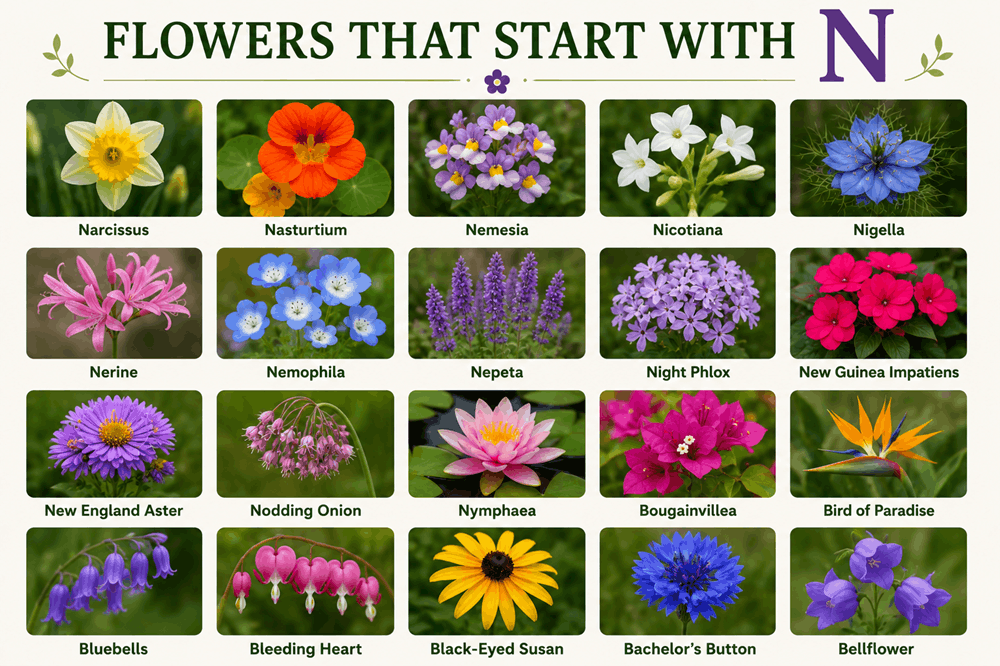
Flowers that start with N include narcissus, nasturtiums, nemesia, nicotiana, nigella, nerine, and many other distinctive blooms. Some are familiar garden annuals, while others grow as bulbs, aquatic plants, flowering shrubs, vines, or native wildflowers. This guide introduces 25 flowers beginning with N, along with their appearance, growing habits, symbolism, and practical uses in gardens, containers, pollinator plantings, and floral arrangements.
1. Narcissus
Narcissus is the botanical group that includes daffodils, paperwhites, and many other familiar spring bulbs. Their flowers usually have six outer petal-like segments surrounding a central trumpet or cup.
Yellow and white are the most familiar colors, but varieties may also feature orange, peach, cream, or soft pink centers.
Narcissus bulbs are generally planted in fall and bloom from late winter through spring. They grow best in well-drained soil with plenty of sunlight during their active season.
The flowers commonly symbolize rebirth, renewal, hope, and the arrival of spring.
2. Nasturtium
Nasturtiums produce cheerful funnel-shaped flowers in yellow, orange, red, peach, cream, and burgundy. Their rounded leaves are almost as recognizable as their flowers.
Both compact and trailing forms are available. Compact varieties work well in garden borders and pots, while trailing nasturtiums can spill from hanging baskets or climb low supports.
Nasturtiums prefer full sun and relatively lean soil. Excessive fertilizer may encourage large leaves at the expense of flowers.
The flowers attract pollinators and bring bright color to warm-season gardens.
3. Nemesia
Nemesia produces masses of small, colorful flowers that resemble miniature snapdragons. Blooms may be white, yellow, orange, pink, purple, blue, red, or bicolored.
The plant performs best during cool or mild weather and often flowers heavily in spring and fall. Some newer varieties tolerate warmth better than older types.
Nemesia works especially well in containers, window boxes, and along the front of flower beds.
Regular watering helps maintain blooming, although the soil should still drain freely.
4. Nemophila
Nemophila is best known through baby blue eyes, a low-growing annual with clear blue flowers and pale centers.
Other species and varieties may produce white, purple, or spotted flowers. The plants form soft spreading mats that look especially effective when planted in large groups.
Nemophila prefers cool spring weather, gentle sunlight, and soil that remains moderately moist.
It works beautifully in wildflower gardens, border edges, and containers where its delicate flowers can be seen up close.
5. Nerine
Nerine is a bulbous plant with clusters of elegant flowers appearing on tall bare stems, often during fall.
Pink is the most familiar color, although white, red, and deeper rose varieties also exist. The narrow petals often curve backward and have a slightly shimmering appearance.
Nerines prefer full sun and excellent drainage. They tend to flower best when the bulbs are not planted too deeply or disturbed frequently.
The late blooming season makes them particularly useful for adding color after many summer flowers have faded.
6. Nicotiana
Nicotiana, commonly called flowering tobacco, produces tubular flowers in white, pink, red, purple, lime green, and cream.
Many varieties release their strongest fragrance during the evening, making them especially attractive near patios and night gardens.
Tall white-flowered forms can become dramatic background plants, while compact varieties are better suited to containers.
Nicotiana prefers sun or light shade and moderately fertile soil. The plant contains nicotine-related compounds and should not be eaten.
7. Nigella
Nigella is commonly known as love-in-a-mist because its flowers are surrounded by fine, threadlike foliage.
Blue is the classic flower color, but varieties also bloom in white, pink, lavender, and purple.
After flowering, nigella develops decorative seed pods that are widely used in dried arrangements.
The plant grows easily from seed and generally prefers direct sowing because it does not enjoy having its roots disturbed.
8. Nierembergia
Nierembergia is commonly known as cupflower. It produces small open flowers in white, lavender, violet, or pale blue.
The plant has a compact or trailing growth habit and works well in containers, border edges, and rock gardens.
Nierembergia prefers full sun or light shade and soil that drains well. In warm climates, some types may grow as perennials, while colder regions usually treat them as annuals.
Its delicate flowers can bloom repeatedly through much of the warm season.
9. Nolana
Nolana produces funnel-shaped flowers that resemble small morning glories. Common colors include blue, lavender, violet, and occasionally white.
The plant is adapted to sunny, relatively dry conditions and often has a spreading or trailing growth habit.
Nolana works particularly well in rock gardens, coastal plantings, containers, and dry border edges.
Good drainage is essential because consistently wet soil can damage the roots.
10. Nymphaea
Nymphaea is the botanical genus containing many water lilies. Their flowers float on or slightly above the water and may be white, pink, red, yellow, blue, or purple.
Water lilies grow from rhizomes rooted in containers or soil below the surface of a pond. Their broad floating leaves provide shade and shelter for aquatic life.
Hardy water lilies can survive cold winters in suitable ponds, while tropical types generally need warmer temperatures.
Water lilies commonly symbolize peace, purity, renewal, and spiritual awakening.
11. Nepeta
Nepeta, commonly known as catmint, produces soft spikes of lavender-blue, purple, pink, or white flowers.
The plant forms loose mounds of aromatic gray-green foliage and flowers for a long period, particularly when trimmed after the first major flush.
Catmint prefers full sun and well-drained soil and becomes drought tolerant after establishment.
Its flowers attract bees and other pollinators, making it useful along paths, borders, and pollinator gardens.
12. New Guinea Impatiens
New Guinea impatiens produce large, colorful flowers above glossy foliage. Blooms may be white, pink, red, orange, lavender, or purple.
Compared with traditional impatiens, these plants generally tolerate more sunlight, especially when given regular moisture.
They are widely used in containers, hanging baskets, and shaded or partly shaded beds.
Many varieties also have attractive bronze, deep green, or variegated leaves that remain decorative even between flowers.
13. New England Aster
New England aster is a tall native perennial with daisy-like flowers in purple, violet, pink, or occasionally white.
It blooms during late summer and fall, providing an important source of nectar when many earlier garden flowers have finished.
The plant prefers full sun and reasonably moist soil. Taller stems can be cut back earlier in the season if a shorter, bushier plant is preferred.
New England asters attract bees, butterflies, and other late-season pollinators.
14. New York Aster
New York aster is another fall-flowering perennial with clusters of purple, blue-violet, pink, or white daisy-like flowers.
The plant is useful in naturalistic borders, meadow gardens, and pollinator plantings.
It performs best with plenty of sunlight and regular moisture. Good air circulation helps keep foliage healthier late in the growing season.
Like other asters, it extends garden color well beyond the peak summer flowering period.
15. Night-Blooming Jasmine
Night-blooming jasmine produces small greenish-white flowers that release an extremely strong fragrance after sunset.
The plant grows as a tropical or subtropical shrub and prefers warm conditions, bright light, and well-drained soil.
Its fragrance can travel a considerable distance, so placement matters. People sensitive to strong scents may prefer to grow it farther from windows and outdoor seating areas.
Despite the common name, night-blooming jasmine is not a true jasmine.
16. Night Phlox
Night phlox produces small star-shaped flowers that become especially fragrant during the evening.
Blooms may be white, pink, purple, or burgundy and often have contrasting centers.
The fragrance is sometimes described as sweet, vanilla-like, or chocolate-like. Planting several together near a patio can create a noticeable scent after sunset.
Night phlox prefers sun or light shade and well-drained soil.
17. Night-Scented Stock
Night-scented stock has relatively small flowers but is grown primarily for its evening fragrance.
The flowers may be pale purple, pink, lavender, or white. They often become more open and noticeable as daylight fades.
This annual performs best during mild weather and is particularly effective beside pathways, patios, and open windows.
Planting several together creates a stronger fragrance than growing one isolated plant.
18. Nodding Onion
Nodding onion is a native ornamental allium with clusters of pink, lavender, or white flowers that bend downward from slender stems.
The rounded flower clusters attract bees, butterflies, and other beneficial insects.
Nodding onion prefers full sun and well-drained soil and can tolerate periods of dryness after establishment.
Its relatively compact size makes it useful in native gardens, rock gardens, and the front of perennial borders.
19. Nodding Trillium
Nodding trillium is a woodland wildflower with three leaves and a three-petaled flower that hangs beneath the foliage.
The bloom is usually white, sometimes developing pinkish tones as it ages.
It grows best in rich woodland soil with spring moisture and summer shade. Trilliums develop slowly and should not be dug from wild populations.
Nursery-propagated plants are the appropriate choice for home woodland gardens.
20. Northern Blue Flag
Northern blue flag is a moisture-loving iris with blue-violet flowers marked with yellow, white, or darker veining.
It grows naturally along pond edges, marshes, wet meadows, and other damp habitats.
The plant is useful in rain gardens and around water features where the soil remains consistently moist.
Its sword-like leaves provide vertical structure even after flowering ends.
21. Nootka Rose
Nootka rose is a wild rose native to western North America. It produces simple pink flowers with prominent yellow centers.
The open blooms attract pollinating insects and are followed by red rose hips later in the season.
The shrub can spread into thickets and is best suited to wildlife gardens, naturalized areas, and larger landscapes rather than very small formal beds.
Its relatively simple flowers show what wild roses looked like before the development of heavily doubled garden cultivars.
22. New Zealand Flax
New Zealand flax is best known for its dramatic sword-like leaves, but mature plants can also produce tall flowering stems.
The tubular flowers are usually red, orange-red, or yellowish and rise well above the foliage.
These blooms can attract nectar-feeding birds in regions where the plant grows successfully.
New Zealand flax prefers mild climates, good drainage, and bright light. Cultivated varieties may have green, bronze, burgundy, pink, or striped foliage.
23. New Zealand Tea Tree
New Zealand tea tree produces small five-petaled flowers in white, pink, or red. Some varieties have simple flowers, while others produce fuller double blooms.
The shrub usually has fine evergreen foliage and prefers full sun with well-drained soil.
It tolerates coastal conditions and can handle some dryness after establishment.
The flowers provide delicate seasonal color while the evergreen structure keeps the plant attractive throughout much of the year.
24. Natal Lily
Natal lily is a common name sometimes used for certain South African flowering plants, particularly clivia. The plant produces clusters of orange, red-orange, yellow, or cream trumpet-shaped blooms.
Clivia grows well in bright indirect light and appreciates a relatively dry resting period before flowering.
It is a popular indoor plant because its dark evergreen leaves remain attractive even when no flowers are present.
Clivia is toxic if eaten, particularly the underground portions, so it should be kept away from pets and small children.
25. Naked Lady
Naked lady is a common name for belladonna lily, which sends up large pink trumpet-shaped flowers on bare stems after its foliage has disappeared.
The unusual sequence explains the common name: the flowers appear without surrounding leaves.
The bulbs perform best in sunny, well-drained locations with warm, dry summers. Once established, they often prefer to remain undisturbed.
The plant is poisonous if eaten, so it should be positioned carefully in gardens used by pets or children.
Which N Flowers Are Best for Containers?
Nasturtiums, nemesia, Nierembergia, New Guinea impatiens, nicotiana, and compact nepeta varieties all work well in containers.
Nasturtiums can spill attractively over pot edges, while nemesia is especially effective in cool-season window boxes. New Guinea impatiens are useful when a patio receives partial shade rather than intense all-day sun.
Every container should have drainage holes. Even plants that appreciate regular watering can suffer when their roots remain submerged for long periods.
Which N Flowers Attract Hummingbirds?
Nicotiana, New Zealand flax, and several other tubular N flowers may attract hummingbirds where the birds and plants share the same region.
Red and orange tubular blooms are particularly noticeable, but flower shape and nectar availability are more important than color alone.
Combine several nectar plants with different blooming periods to create a more reliable hummingbird garden.
Which N Flowers Attract Bees and Butterflies?
Nepeta, nasturtiums, nodding onion, New England asters, New York asters, Nootka rose, and nigella can all support pollinating insects.
Fall-blooming asters are especially valuable because they provide nectar and pollen late in the growing season.
Planting several specimens together makes the flowers easier for insects to locate and allows pollinators to move efficiently between blooms.
Which N Flowers Work Well in Bouquets?
Narcissus, nerine, nigella, nicotiana, New England asters, and Nootka rose can all be used in arrangements, although some require special handling.
Nigella provides delicate flowers as well as ornamental seed pods, while nerine creates elegant late-season color. Asters add texture and a natural garden style.
Freshly cut narcissus stems release sap that may shorten the vase life of other flowers. Allow them to condition separately in water before combining them with a mixed bouquet.
Which N Flowers Are Best for Shade?
New Guinea impatiens, nodding trillium, and some woodland-adapted native N flowers perform well in partial shade.
Nodding trillium is particularly suited to areas beneath deciduous trees where spring sunlight reaches the ground before the leaves fully emerge.
Nasturtiums, Nolana, nepeta, and most asters generally flower better in brighter locations.
Which N Flowers Are Best for Wet Areas?
Northern blue flag and many water lilies are excellent choices for consistently wet conditions.
Northern blue flag can grow along pond edges and in rain gardens, while Nymphaea requires permanent standing water.
Do not assume that all moisture-loving plants want their roots submerged. Match each species to the correct water depth and soil conditions.
Which N Flowers Need Extra Caution?
Several N flowers can be toxic if eaten. Narcissus bulbs contain compounds that can cause significant digestive symptoms, while nicotiana contains nicotine-related chemicals.
Night-blooming jasmine, clivia, and naked lady also require caution around pets and children.
Plant names can be misleading, particularly when regional common names are used. Identifying the botanical species is the safest approach when toxicity or pet safety is important.
The Bottom Line
Flowers that start with N include familiar choices such as narcissus, nasturtiums, nemesia, nicotiana, nigella, and nerine. The group also contains less familiar flowers such as Nierembergia, Nolana, nodding onion, Nootka rose, and northern blue flag.
There are N flowers for many different garden settings. Nasturtiums thrive in sunny containers, New Guinea impatiens brighten partly shaded areas, northern blue flag enjoys wet soil, and water lilies grow directly in ponds. Night phlox and night-scented stock become especially interesting after sunset.
When choosing an N flower, consider its sunlight, moisture, soil, climate, mature size, toxicity, and potential to spread. Matching each plant to the right environment will produce healthier growth, stronger flowering, and a garden with greater color and interest throughout the year.