What Flowers Are Used in Perfumes? Twenty Fragrant Blooms Behind Famous Scents
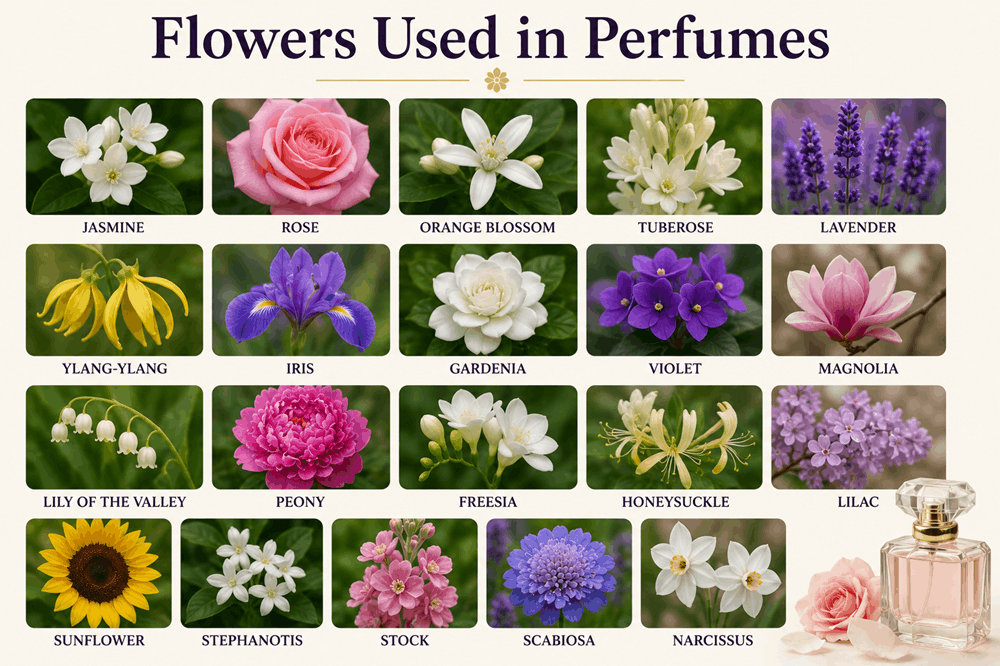
Flowers used in perfumes include jasmine, rose, orange blossom, tuberose, lavender, ylang-ylang, gardenia, violet, iris, magnolia, and many others. Some provide actual essential oils or fragrant extracts, while others are recreated with combinations of natural and synthetic aroma materials. Each flower contributes a different character, ranging from fresh and powdery to creamy, spicy, green, sweet, or intensely sensual.
Why Are Flowers Used in Perfume?
Flowers contain aromatic compounds that help attract pollinators and communicate with the surrounding environment. Humans have used these fragrances for centuries in oils, incense, cosmetics, bathing products, and eventually modern perfume.
In perfumery, floral materials can serve several purposes. A flower may become the dominant scent of a fragrance, soften sharper ingredients, add sweetness, or connect citrus, woody, spicy, and musky notes together.
Some perfumes are built around one recognizable flower. Others create a floral bouquet in which several flower scents blend together.
The smell of the living flower and the smell found inside a perfume are not always identical. Extraction can emphasize certain aromatic molecules while losing others. In some cases, the flower produces too little usable oil to be extracted economically, so perfumers recreate its scent using other materials.
1. Jasmine
Jasmine is one of the most important flowers in traditional perfumery. Its fragrance is rich, sweet, warm, slightly fruity, and sometimes described as animalic or sensual.
Two commonly associated perfume jasmines are Jasminum grandiflorum and Jasminum sambac. Their scents are similar but not identical. Sambac jasmine often has a greener, more exotic character, while grandiflorum can smell softer and more classically floral.
Jasmine is usually extracted rather than steam-distilled because high heat can damage its delicate fragrance. The resulting jasmine absolute is powerful and expensive, so even small quantities can have a noticeable effect.
It is often paired with rose, orange blossom, tuberose, sandalwood, amber, vanilla, and musk.
2. Rose
Rose is another foundation of floral perfumery. Depending on the variety and extraction method, rose can smell fresh, green, honeyed, spicy, fruity, powdery, or deeply romantic.
Damask rose and Rosa centifolia are among the best-known roses used for fragrance production.
Rose oil, sometimes called rose otto, can be produced through steam distillation. Rose absolute is produced through solvent extraction and usually has a fuller, richer scent closer to fresh petals.
A perfume labeled as rose does not necessarily contain only natural rose material. Many modern rose accords combine natural extracts with aroma molecules to create a particular style or improve consistency.
3. Orange Blossom
Orange blossom comes from the flowers of the bitter orange tree. Its scent is bright, floral, slightly citrusy, sweet, and clean.
Several perfume ingredients can come from the same tree. Steam-distilling the flowers produces neroli oil, while solvent extraction creates orange blossom absolute.
Neroli tends to smell lighter, greener, and fresher. Orange blossom absolute is usually richer, sweeter, and more intensely floral.
Orange blossom works beautifully in fresh citrus fragrances, white-floral perfumes, colognes, and sweet amber compositions.
4. Tuberose
Tuberose is known for one of the strongest floral scents used in perfume. Its creamy white flowers release an intense fragrance that can smell sweet, buttery, green, tropical, and almost narcotic.
Despite its name, tuberose is not related to roses.
Its richness makes it a classic ingredient in dramatic white-floral perfumes. Perfumers often combine it with jasmine, orange blossom, ylang-ylang, vanilla, coconut-like notes, and warm woods.
Because tuberose can easily dominate a formula, small adjustments can completely change the character of a perfume.
5. Ylang-Ylang
Ylang-ylang comes from the fragrant yellow flowers of a tropical tree. Its scent is sweet, creamy, exotic, slightly fruity, and sometimes reminiscent of banana, custard, or jasmine.
The flowers are commonly steam-distilled, and different fractions can be collected during the distillation process. These fractions vary in richness and aromatic character.
Ylang-ylang is especially important in floral, tropical, amber, and oriental-style fragrances.
It combines well with jasmine, rose, citrus oils, sandalwood, vanilla, and patchouli.
6. Lavender
Lavender gives perfume a fresh, aromatic, herbal, floral quality. Its fragrance can include cool, clean, slightly woody, and mildly sweet notes.
Lavender has traditionally played a major role in fougère fragrances, colognes, soaps, and aromatic perfumes.
Lavender essential oil is typically obtained through steam distillation of the flowering tops.
It pairs naturally with citrus, rosemary, sage, geranium, tonka bean, vanilla, woods, and musks.
7. Iris
Iris is unusual because the prized perfume material does not normally come from the fresh flower. It comes from the underground rhizomes of certain iris plants.
These rhizomes are harvested, dried, and aged before being processed into orris materials.
Orris has a soft, powdery, woody, violet-like scent with a luxurious texture. It is among the most expensive traditional perfume ingredients because cultivation and processing take several years.
Iris fragrances are often described as elegant, cool, cosmetic, or reminiscent of fine face powder.
8. Violet
Violet has a delicate sweet, powdery, slightly green fragrance. However, the familiar scent of violet flowers is difficult to capture through conventional extraction.
Modern violet perfumes therefore rely heavily on aroma molecules that reproduce the characteristic violet smell.
Violet leaf is a separate perfume material with a much greener scent. It can smell watery, leafy, metallic, and fresh rather than sweet and powdery.
Violet works well with iris, rose, musk, woods, and soft powdery accords.
9. Gardenia
Gardenia flowers smell creamy, rich, sweet, and intensely white-floral, with green and sometimes mushroom-like undertones.
Natural gardenia fragrance is difficult to capture economically, so many gardenia perfumes use a carefully constructed accord rather than large amounts of natural flower extract.
Perfumers may combine jasmine-like materials, tuberose notes, green components, lactones, and other aroma molecules to suggest the smell of fresh gardenia.
The result can range from airy and clean to dense, tropical, and sensual.
10. Magnolia
Magnolia flowers often have a fresh, creamy, lemony floral scent. Some varieties lean toward citrus, while others are sweeter and more velvety.
Magnolia is popular in modern perfumes because it can create a floral effect without becoming as heavy as tuberose or jasmine.
It works particularly well in fresh floral fragrances combined with citrus, musk, tea, soft woods, and watery notes.
11. Lily of the Valley
Lily of the valley has a fresh, green, slightly watery floral scent associated with spring.
The flower itself does not provide a practical essential oil for traditional perfumery. Its aroma is normally recreated with fragrance materials designed to reproduce its clean, bell-like floral character.
This style of scent is often called muguet, from the French name for lily of the valley.
Muguet notes can make a perfume smell clean, bright, airy, and freshly washed.
12. Hyacinth
Hyacinth has a strong spring fragrance combining green, floral, watery, and slightly spicy qualities.
Its scent can feel almost cool or damp, recalling freshly cut stems and spring gardens after rain.
Natural hyacinth extracts are uncommon in mainstream perfume, so the recognizable fragrance is often reconstructed from other materials.
Hyacinth accords appear in green florals, vintage-inspired perfumes, and compositions designed to suggest fresh gardens.
13. Narcissus
Narcissus provides a complex scent that can be floral, green, earthy, honeyed, animalic, and slightly leathery at the same time.
Some narcissus flowers are processed into valuable absolutes used in fine fragrance.
Unlike simple sweet florals, narcissus adds depth and personality. It can make a fragrance feel wild, natural, and slightly mysterious.
It blends particularly well with jasmine, tuberose, mossy notes, leather accords, woods, and other green florals.
14. Osmanthus
Osmanthus produces tiny flowers with a surprisingly powerful scent. Its fragrance is floral and fruity, with notes often compared to apricot, peach, suede, or tea.
This unusual combination makes osmanthus especially useful in perfumes that bridge floral and fruity categories.
Osmanthus absolute can add a velvety, slightly leathery quality without making the fragrance smell heavily floral.
It works well with tea, rose, violet, leather, musk, sandalwood, and fruity notes.
15. Frangipani
Frangipani, also called plumeria, has a tropical floral scent that can smell creamy, fruity, sweet, and slightly citrusy.
The living flowers are highly fragrant, but perfume interpretations often rely on reconstructed accords rather than traditional essential oils.
Frangipani is frequently associated with warm-weather fragrances, tropical gardens, beaches, and exotic floral bouquets.
It combines naturally with coconut, vanilla, jasmine, ylang-ylang, citrus, and creamy woods.
16. Honeysuckle
Honeysuckle flowers have a sweet, nectar-like fragrance with green, honeyed, and slightly fruity qualities.
The recognizable honeysuckle scent found in perfume is often recreated rather than obtained as a widely used natural extract.
It works especially well in spring and summer fragrances, where it can create the impression of warm air, flowering vines, and garden sweetness.
Honeysuckle can be paired with jasmine, citrus, rose, orange blossom, green leaves, and musk.
17. Lilac
Lilacs have a distinctive spring scent that is sweet, fresh, powdery, and slightly green.
Despite the intensity of a blooming lilac shrub, its characteristic fragrance is not easily produced as a conventional essential oil.
Perfumers typically construct a lilac accord using combinations of aromatic materials that suggest the natural flower.
Lilac scents are often used in soft floral perfumes designed to feel nostalgic, airy, and springlike.
18. Peony
Peony is extremely popular in modern floral fragrances, but the perfume industry does not generally rely on a traditional peony essential oil.
Instead, perfumers build peony accords that capture the impression of fresh pink petals.
These accords are often rosy, watery, clean, slightly fruity, and transparent rather than heavy.
Peony combines easily with rose, lychee, pear, citrus, musk, freesia, and soft woods, which is why it appears frequently in light contemporary perfumes.
19. Freesia
Freesia has a fresh, airy floral scent with subtle fruity and peppery qualities.
Like several delicate flowers, freesia is usually represented in perfume through reconstructed accords rather than a widely used natural essential oil.
Its light character makes it useful in clean floral fragrances that are designed to smell bright rather than intensely sweet.
Freesia often appears alongside peony, rose, pear, citrus, lily of the valley, and musk.
20. Champaca
Champaca is a highly fragrant flower related to magnolia. Its scent is warm, floral, fruity, slightly spicy, and sometimes tea-like.
Champaca materials can contribute considerable depth to a fragrance and are often used in luxurious floral and amber compositions.
Its rich scent pairs well with jasmine, rose, sandalwood, incense, amber, spices, and tropical floral notes.
How Are Flower Scents Extracted?
Perfumers use several techniques to obtain aromatic materials from flowers. The best method depends on how delicate the flower is and how its fragrance compounds respond to heat.
Steam Distillation
Steam passes through plant material and carries volatile aromatic compounds with it. After cooling, the essential oil separates from the water.
Lavender, rose, neroli, and ylang-ylang can all provide materials through distillation.
Solvent Extraction
Delicate flowers such as jasmine may lose important parts of their scent when exposed to the heat of steam distillation.
Solvents can extract aromatic compounds more gently. The process can eventually produce a concentrated material known as an absolute.
Jasmine absolute, rose absolute, orange blossom absolute, tuberose absolute, and narcissus absolute are examples used in fine fragrance.
Carbon Dioxide Extraction
Carbon dioxide extraction can capture aromatic components at relatively low temperatures. The technique can create extracts that smell different from traditional essential oils or absolutes.
It is used for certain botanical ingredients where a detailed natural aroma is desired.
Why Aren’t All Floral Perfumes Made From Real Flowers?
A bottle labeled lilac, gardenia, peony, or lily of the valley does not necessarily contain an extract from those flowers.
Some flowers produce almost no usable essential oil. Others lose their recognizable scent during extraction, require enormous quantities of petals, or are too expensive to use in substantial amounts.
Perfumers solve this problem by creating accords.
An accord is a combination of several fragrance materials designed to produce a new overall impression. Just as several musical notes form a chord, several aroma materials can combine to smell like a flower even when that flower itself is absent.
Synthetic aroma molecules can also improve consistency. Natural flowers change slightly depending on weather, soil, harvest timing, and location, while manufactured fragrance ingredients can provide the same scent profile from batch to batch.
What Are White Flowers in Perfume?
“White floral” is a common perfume description referring to a family of intensely fragrant flowers that often happen to have white or pale petals.
Typical white florals include:
- Jasmine
- Tuberose
- Orange blossom
- Gardenia
- Frangipani
- Magnolia
- Stephanotis
White-floral perfumes are often creamy, sweet, sensual, and powerful. However, they can also be made fresh and transparent depending on the supporting ingredients.
Which Flowers Make Perfume Smell Powdery?
Iris and violet are two of the strongest flowers associated with powdery perfume.
Rose can also contribute a powdery quality, especially when blended with iris, violet, heliotrope, vanilla, or soft musks.
Powdery perfumes often recall cosmetics, face powder, lipstick, clean fabric, or soft skin.
Which Flowers Create Fresh Perfumes?
Lily of the valley, freesia, peony, orange blossom, magnolia, lavender, and certain roses can create fresher floral compositions.
Perfumers may combine them with citrus, green leaves, watery accords, herbs, and clean musks to make the fragrance feel lighter.
A perfume does not have to smell sweet simply because flowers are its main ingredients.
Which Flowers Create Strong, Sensual Perfumes?
Jasmine, tuberose, ylang-ylang, gardenia, narcissus, and champaca are among the flowers most associated with rich and sensual fragrances.
These materials often work with amber, vanilla, musk, sandalwood, patchouli, incense, and spices.
The concentration matters as much as the flower. A small amount of jasmine can add warmth to a light fragrance, while a large white-floral accord can dominate the entire perfume.
The Bottom Line
Many of the world’s best-known perfumes are built around flowers. Rose and jasmine remain foundational materials, while orange blossom, tuberose, ylang-ylang, lavender, iris, narcissus, and osmanthus provide distinctive natural extracts.
Other familiar perfume flowers, including gardenia, lily of the valley, lilac, peony, freesia, honeysuckle, and violet, are often recreated through carefully constructed accords because their natural fragrances are difficult or impractical to extract.
Each flower contributes something different. Jasmine can be rich and sensual, lavender aromatic and clean, iris powdery and elegant, orange blossom luminous and sweet, and osmanthus fruity and leathery. That variety is why flowers remain at the heart of perfumery: they can make a fragrance smell fresh, romantic, mysterious, comforting, luxurious, or entirely unexpected.