Flowers That Start With H: Twenty-Five Beautiful Blooms for Every Garden Style
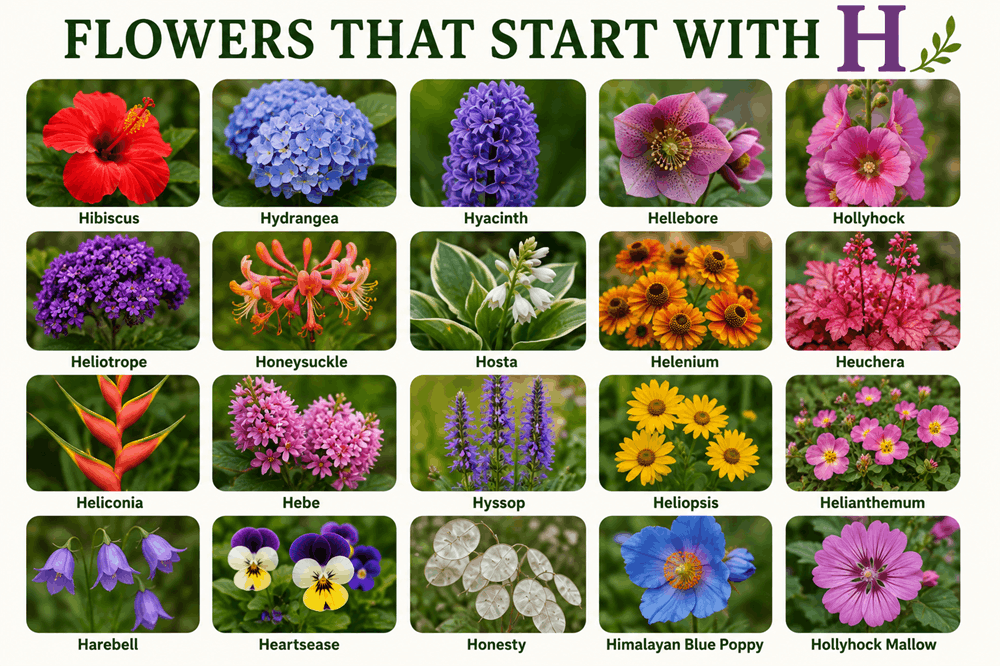
Flowers that start with H include hibiscus, hydrangeas, hyacinths, hellebores, hollyhocks, honeysuckle, heliotrope, and many other distinctive blooms. Some are tropical showpieces, while others are hardy perennials, flowering shrubs, woodland plants, vines, or cottage-garden favorites. This guide introduces 25 flowers beginning with H, along with their appearance, growing habits, symbolism, and practical uses in gardens and bouquets.
1. Hibiscus
Hibiscus is one of the most recognizable flowers beginning with H. Its large, trumpet-shaped blooms often have prominent central stamens extending beyond the petals.
Flowers may be red, pink, orange, yellow, white, purple, or multicolored. Tropical hibiscus thrives in warm climates, while hardy hibiscus varieties can survive winters in much colder regions.
Most hibiscus plants prefer plenty of sunlight, fertile soil, and consistent moisture during active growth. Their dramatic flowers make them excellent focal points in borders and large containers.
Hibiscus commonly symbolizes beauty, femininity, hospitality, and the temporary nature of life because individual flowers may last only a short time.
2. Hydrangea
Hydrangeas produce enormous flower clusters that can cover a shrub during summer. Their blooms may be blue, pink, purple, white, green, or red depending on the variety.
Some types form rounded mophead flowers, while lacecap hydrangeas have flatter clusters with small fertile flowers surrounded by larger decorative blooms.
Many hydrangeas prefer morning sunlight with afternoon shade and consistently moist soil. Certain varieties can change between blue and pink depending partly on soil chemistry and aluminum availability.
Hydrangeas are commonly associated with gratitude, understanding, abundance, and heartfelt emotion.
3. Hyacinth
Hyacinths are spring-flowering bulbs known for dense spikes of highly fragrant flowers. Their colors include blue, purple, white, pink, red, peach, and yellow.
They grow best in sunny or lightly shaded areas with good drainage. Bulbs are generally planted in fall so they can experience the cold period necessary for spring flowering.
Hyacinths are especially effective near entrances and pathways where their fragrance can be appreciated.
The bulbs contain irritating compounds and should be kept away from pets and children that may dig them up or chew them.
4. Hellebore
Hellebores are among the earliest perennial flowers to bloom, sometimes opening while snow is still on the ground. Their nodding flowers may be white, cream, pink, burgundy, purple, green, yellow, or spotted.
These shade-tolerant plants work beautifully beneath deciduous trees and shrubs. They prefer rich, well-drained soil and usually become more impressive as the clumps mature.
Hellebores are sometimes called Christmas roses or Lenten roses, although they are not true roses.
All parts of the plant are toxic if eaten, so they should be handled and positioned carefully.
5. Hollyhock
Hollyhocks produce towering flower stalks lined with large open blooms. They are classic cottage-garden plants and can reach heights of six feet or more.
Flowers may be pink, red, yellow, white, peach, purple, burgundy, or nearly black. Both single and heavily doubled varieties are available.
Hollyhocks prefer full sun and good airflow. Rust disease can become a problem in humid or crowded conditions, so remove infected leaves and avoid overhead watering when possible.
The flowers are often associated with ambition, abundance, and the traditional charm of old-fashioned gardens.
6. Heliotrope
Heliotrope produces rounded clusters of tiny purple, blue, lavender, or white flowers. Its most memorable feature is its fragrance, often compared with vanilla, cherry pie, or almond.
The plant prefers warmth, sunlight, fertile soil, and regular moisture. It can grow as a perennial in frost-free climates but is commonly treated as an annual elsewhere.
Heliotrope works especially well in containers and near patios where its scent can be enjoyed.
The plant should not be eaten and is best kept away from pets that habitually chew garden plants.
7. Heather
Heather forms low evergreen shrubs covered with many tiny flowers. Colors include purple, pink, red, lavender, and white.
It performs best in acidic, well-drained soil and is particularly useful in rock gardens, heath gardens, containers, and open landscapes.
Different varieties bloom at different times, allowing gardeners to create displays that continue across several seasons.
Heather commonly symbolizes admiration, protection, good luck, and solitude.
8. Honeysuckle
Honeysuckle produces tubular flowers with a sweet fragrance and abundant nectar. Depending on the species, the blooms may be red, coral, orange, yellow, pink, or white.
Native trumpet honeysuckles are particularly valuable in hummingbird gardens because their long flowers are easy for the birds to feed from.
Some honeysuckles grow as vines, while others form shrubs. Species selection matters because several non-native honeysuckles can become invasive.
Choose a locally appropriate native species whenever possible.
9. Hosta
Hostas are primarily grown for their foliage, but they also produce attractive flowers on tall stems above the leaves.
The blossoms are usually white, pale lavender, or purple and may be bell-shaped or trumpet-shaped. Some varieties are noticeably fragrant.
Hostas thrive in partial or full shade and prefer rich soil with consistent moisture. Their leaves range from deep green to blue-gray, gold, cream, and variegated combinations.
Hostas are toxic to cats and dogs when eaten.
10. Helenium
Helenium produces warm-toned daisy-like flowers in yellow, orange, bronze, red, and combinations of these shades.
It blooms from summer into fall and can provide valuable late-season color when many earlier perennials have finished flowering.
Helenium prefers full sun and soil that does not become excessively dry. Taller varieties may benefit from support or early-season pruning to encourage stronger branching.
The flowers attract bees, butterflies, and other pollinators.
11. Heuchera
Heuchera, commonly called coral bells, produces delicate sprays of tiny flowers above colorful foliage. The blooms may be white, pink, coral, or red.
The leaves are equally important and can be green, purple, bronze, silver, caramel, red, or almost black.
Heuchera performs well near the front of borders and in partly shaded gardens. Red-flowered varieties may attract hummingbirds.
Good drainage is important, particularly during winter when wet soil can damage the crown.
12. Heliconia
Heliconia is a tropical plant with dramatic structures in red, orange, yellow, pink, or combinations of bright colors.
What looks like the flower is largely made up of colorful bracts surrounding much smaller true flowers.
Heliconias thrive in warm, humid environments with rich soil and regular moisture. Depending on the species, their flower structures may stand upright or hang downward.
They create a striking tropical effect in gardens and are also widely used as long-lasting cut flowers.
13. Hemerocallis
Hemerocallis is the botanical genus for daylilies. These hardy perennials produce trumpet-shaped blooms in yellow, orange, red, pink, cream, purple, and multicolored forms.
Each individual flower generally lasts for only one day, but mature plants produce many buds over several weeks.
Daylilies tolerate a wide range of garden conditions and perform best with plenty of sunlight.
They are extremely dangerous to cats. Eating even a small amount can cause severe kidney failure.
14. Hamamelis
Hamamelis is better known as witch hazel. It is a deciduous shrub or small tree with unusual ribbon-like flowers that appear when few other woody plants are blooming.
Flowers may be yellow, orange, red, or copper and often have a light fragrance.
Depending on the species and variety, witch hazel can bloom during fall, winter, or very early spring.
It works well as a specimen shrub in woodland gardens and landscapes designed for year-round interest.
15. Hoya
Hoya is a popular houseplant known for waxy clusters of star-shaped flowers. The blooms may be white, pink, cream, red, burgundy, or greenish, often with contrasting centers.
Many hoyas have sweet fragrance, especially during the evening. Their thick leaves and trailing or climbing stems make them well suited to hanging baskets and indoor trellises.
Hoyas prefer bright indirect light and a loose potting mixture that drains rapidly. Allowing the soil to dry slightly between waterings generally works better than keeping it constantly saturated.
A mature hoya may flower repeatedly from the same spur, so old flower stalks should not automatically be removed.
16. Hebe
Hebe is an evergreen shrub with spikes of small flowers in purple, blue, pink, white, or lavender.
Different varieties range from compact ground-level plants to larger shrubs several feet tall. Many have attractive evergreen leaves in green, gray, purple, or variegated forms.
Hebes prefer sunny, well-drained locations and mild climates. They can suffer in areas with prolonged severe frost.
The flowers attract bees and other pollinating insects during summer.
17. Hyssop
Hyssop produces upright spikes of small blue, purple, pink, or white flowers. The aromatic foliage gives the plant additional garden interest.
True hyssop prefers full sun and well-drained soil and becomes reasonably drought tolerant after establishment.
The flowers attract bees and butterflies, making hyssop useful in herb gardens and pollinator plantings.
Several unrelated plants also contain “hyssop” in their common names, so check the botanical identity when choosing one for a particular purpose.
18. Heliopsis
Heliopsis is commonly called false sunflower because its bright yellow or orange flowers resemble smaller sunflowers.
This dependable perennial blooms for a long period during summer and can continue into early fall.
Heliopsis prefers full sun and tolerates a range of ordinary garden soils. Removing faded flowers encourages continued blooming and keeps the plant looking tidy.
The flowers attract bees, butterflies, and other beneficial insects.
19. Helianthemum
Helianthemum, commonly called rock rose or sun rose, forms low evergreen or semi-evergreen mounds covered with small open flowers.
Blooms may be yellow, orange, pink, red, white, or peach. Individual flowers may not last long, but the plant produces many over its flowering period.
Helianthemum thrives in full sun and sharply drained soil. It is particularly useful in rock gardens, gravel gardens, walls, and dry border edges.
Avoid planting it in locations that remain wet during winter.
20. Harebell
Harebell produces delicate blue, violet, or occasionally white bell-shaped flowers on slender stems.
The plant has a light, airy appearance and grows naturally in grasslands, rocky areas, coastal landscapes, and open woodland habitats depending on the species.
Harebells work well in naturalistic and cottage gardens where their fine stems can move freely in the breeze.
They are commonly associated with humility, gratitude, and constancy.
21. Heartsease
Heartsease is a small wild pansy with charming flowers often combining purple, yellow, blue, and white.
It is closely related to the cultivated pansies commonly grown in containers and cool-season flower beds.
Heartsease grows best in mild temperatures and may decline during intense summer heat. It can reseed naturally when growing conditions are favorable.
The flower has a long association with remembrance, affection, and thoughts of loved ones.
22. Honesty
Honesty is a biennial or short-lived perennial with purple or white spring flowers. After flowering, it develops distinctive flat, silvery seed pods.
The translucent pods are often more famous than the flowers themselves and are widely used in dried arrangements.
Honesty grows well in sun or partial shade and may reseed generously in informal gardens.
The plant is particularly effective in cottage gardens and woodland edges where its natural spreading habit is welcome.
23. Himalayan Blue Poppy
Himalayan blue poppy is famous for its extraordinary sky-blue flowers with golden centers.
Despite its beauty, it can be difficult to grow. The plant prefers cool summers, high humidity, rich acidic soil, and consistent moisture without waterlogging.
It generally struggles in regions with intense heat, dry summers, or warm nights.
Where the climate is suitable, its unusual blue flowers make it one of the most memorable plants in a shaded or woodland garden.
24. Hawkweed
Hawkweed produces small daisy-like flowers, usually in yellow or orange, above low-growing foliage.
Some species can spread rapidly through runners or seed and may behave aggressively in lawns, meadows, and disturbed ground.
Orange hawkweed is visually attractive, but gardeners should check local invasive-plant guidance before introducing it. In some areas, controlling existing populations is preferable to deliberately planting it.
25. Hollyhock Mallow
Hollyhock mallow is a perennial with open, cup-shaped flowers resembling smaller hollyhocks. Blooms may be pink, purple, rose, or white.
The plant creates a softer, bushier effect than tall traditional hollyhocks and works well in cottage gardens and mixed perennial borders.
It prefers plenty of sunlight and reasonably well-drained soil. Removing faded flowers can encourage additional blooming and limit unwanted reseeding.
Which H Flowers Are Best for Containers?
Hibiscus, heliotrope, heuchera, hoya, compact hebes, heartsease, and smaller hydrangeas can all grow successfully in containers.
Tropical hibiscus needs plenty of light and regular feeding during summer, while hoya is better suited to bright indoor light. Heuchera performs well in containers that receive partial shade.
Hydrangeas require larger pots because they have substantial root systems and need consistent moisture. Whatever flower you choose, make sure the container has drainage holes.
Which H Flowers Attract Hummingbirds?
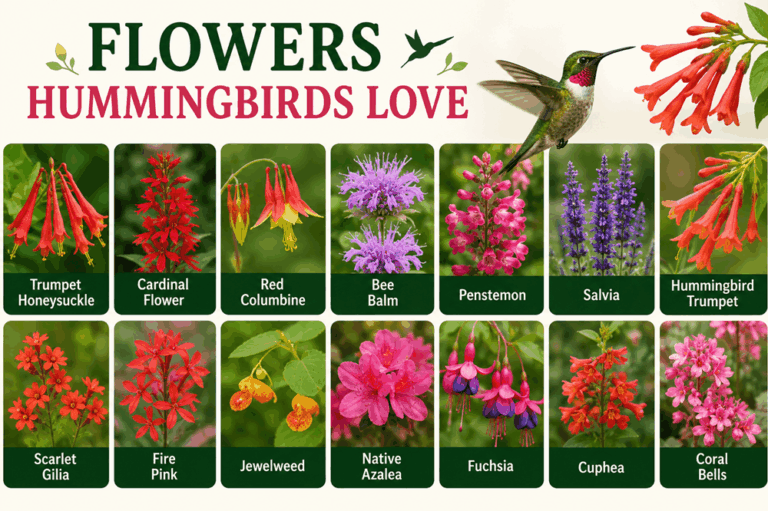
Honeysuckle, hibiscus, heuchera, and certain other tubular H flowers can attract hummingbirds.
Native trumpet honeysuckle is one of the strongest choices because its flowers naturally suit the shape of a hummingbird’s bill. Red and coral heuchera varieties can also provide nectar.
Planting flowers in noticeable groups helps hummingbirds find them more easily. A garden containing several overlapping bloom periods will provide a more dependable food source than one plant flowering for only a few weeks.
Which H Flowers Attract Bees and Butterflies?
Helenium, hebe, hyssop, heliopsis, heather, honeysuckle, and open-flowered hibiscus varieties can all support pollinating insects.
Simple flowers are often more useful than heavily doubled varieties because bees can reach their pollen and nectar more easily.
A strong pollinator garden should include flowers from spring through fall and avoid unnecessary broad-spectrum insecticides.
Which H Flowers Work Well in Bouquets?
Hydrangeas, hellebores, hyacinths, helichrysum-type everlasting flowers, heliconias, heuchera stems, and hibiscus can all be incorporated into floral arrangements, although their vase lives differ significantly.
Hydrangeas create large areas of color, while heliconias provide bold tropical structure. Hyacinths offer intense fragrance, and hellebore stems bring a softer garden style.
Cut flowers during the cooler part of the morning and place them in water quickly. Hydrangeas are particularly sensitive to dehydration and should not remain dry for long periods.
Which H Flowers Are Best for Shade?
Hostas, hellebores, heucheras, epimedium-like woodland companions, and some hydrangeas perform well with partial shade.
Hostas can tolerate considerable shade, although many varieties flower better when they receive some gentle morning light.
Hellebores are excellent beneath deciduous trees because they receive more sunlight during winter and early spring before the tree canopy becomes dense.
Which H Flowers Need Extra Caution?
Several H plants require careful placement around pets and children. Daylilies are extremely toxic to cats, while hostas can poison cats and dogs when eaten. Hyacinth bulbs and hellebore plants also contain irritating or toxic compounds.
Do not assume a flower is safe simply because it is commonly grown in gardens. Plant toxicity varies widely, and problems may involve the flowers, leaves, stems, roots, bulbs, berries, or sap.
If pets regularly chew vegetation, identify each plant before introducing it to the yard or home.
The Bottom Line
Flowers that start with H include familiar garden favorites such as hibiscus, hydrangeas, hyacinths, hellebores, hollyhocks, hostas, and honeysuckle.
The group also includes unusual choices such as heliconia, Himalayan blue poppy, helianthemum, harebell, honesty, and fragrant hoyas. Some thrive in full sun, while others are ideal for shaded woodland gardens or indoor containers.
When choosing an H flower, consider its climate, sunlight, soil, moisture needs, mature size, potential invasiveness, and toxicity. Matching each plant to the right setting will produce healthier growth and more flowers than choosing a variety based on appearance alone.