What Flowers Are in Season? A Practical Guide for Every Month and Occasion
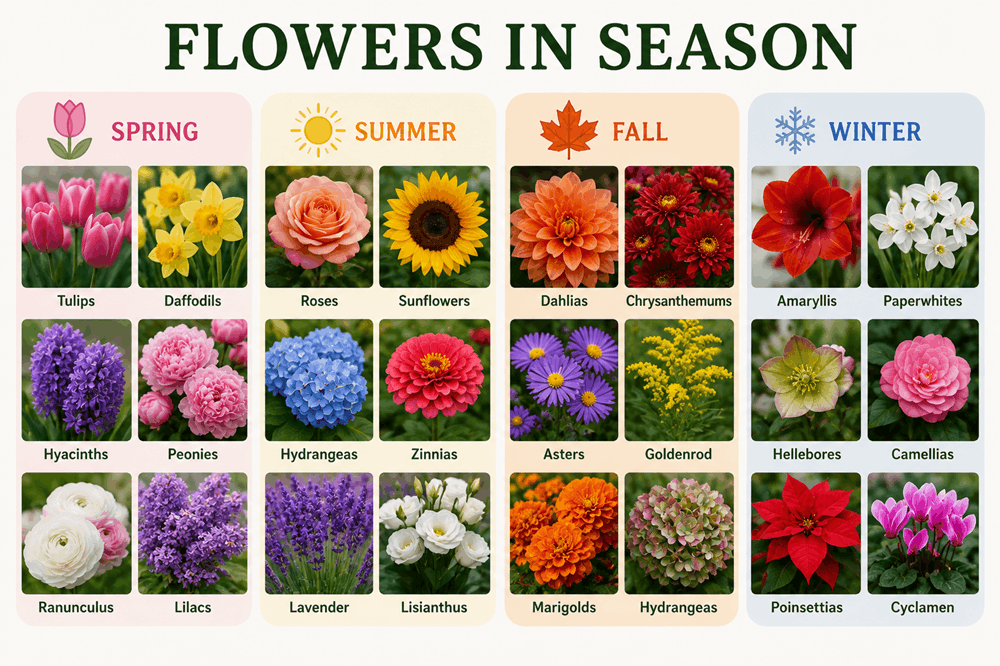
What flowers are in season depends on your climate, location, and whether you are buying locally grown or imported blooms. In much of the Northern Hemisphere, tulips and daffodils dominate spring, roses and sunflowers peak in summer, dahlias and chrysanthemums shine in fall, and amaryllis, hellebores, and paperwhites brighten winter. Choosing seasonal flowers usually means better freshness, stronger stems, wider availability, and more reasonable prices.
Why Flower Season Matters
Most popular flowers can now be purchased during several parts of the year because commercial growers use greenhouses, controlled temperatures, and international shipping. That does not mean every flower is naturally in season whenever it appears at a florist.
A flower is generally considered in season when it naturally grows and blooms under the current outdoor conditions in a particular region. Seasonal flowers are often easier to source locally and may spend less time in refrigerated storage or transportation.
Choosing flowers during their natural season can offer several advantages:
- Fresher blooms and firmer stems
- Better availability from local growers
- More natural-looking colors and forms
- Lower prices during peak production
- Longer vase life when the flowers are recently cut
- A stronger connection to the time of year
Seasonality is especially important when planning a wedding, event, garden, or large floral order. A flower that is abundant in May may become expensive or difficult to find in November.
Spring Flowers in Season
Spring is associated with bulbs, flowering branches, cool-season annuals, and the first waves of perennial blooms. Many spring flowers have soft colors and delicate forms, although bold reds, purples, and yellows are also common.
Tulips
Tulips are among the most recognizable spring flowers. Their natural season usually runs from late winter through mid-spring, depending on the climate and variety.
They are available in almost every color, including white, cream, yellow, orange, pink, red, purple, and near-black. Some have fringed, double, striped, or parrot-like petals.
Tulips continue growing after they are cut, so their stems may lengthen and curve in a vase. This movement is normal and contributes to their relaxed appearance.
Daffodils
Daffodils bloom from late winter into spring. Their yellow, white, orange, and peach flowers are strongly associated with renewal and warmer weather.
Freshly cut daffodils release a sap that can shorten the life of other flowers. Condition them separately in water before combining them with tulips, roses, or other blooms.
Hyacinths
Hyacinths produce dense spikes of highly fragrant flowers. Their colors include white, blue, purple, pink, red, and yellow.
They are most naturally available in early and mid-spring. Their strong scent works well in small arrangements but may be overwhelming in enclosed rooms.
Peonies
Peonies have a relatively short natural season, usually from late spring into early summer. Their large, layered flowers make them popular for weddings and romantic arrangements.
Common colors include white, blush, coral, pink, red, and burgundy. Because the season is concentrated, prices may rise sharply outside the main blooming period.
Ranunculus
Ranunculus flowers have tightly layered petals that resemble miniature roses. They are often available from late winter through spring.
Their colors range from white and cream to yellow, orange, pink, red, purple, and multicolored combinations. Their relatively long vase life makes them useful in bouquets and centerpieces.
Anemones
Anemones are popular spring flowers with open petals and dark central disks. White anemones with black centers are especially common in modern floral designs.
They are also available in pink, purple, red, blue, and burgundy. Their natural season often overlaps with ranunculus and early peonies.
Sweet Peas
Sweet peas bloom during cool spring weather and are known for their soft fragrance and delicate ruffled petals.
They may be white, pink, lavender, purple, coral, red, or bicolored. Sweet peas are fragile and usually do not last as long as carnations or chrysanthemums, but their scent and movement make them highly valued.
Lilacs
Lilacs bloom for a short period in mid-to-late spring. Their fragrant clusters may be purple, lavender, pink, white, or deep magenta.
Cut lilacs can wilt quickly if their woody stems are not properly conditioned. Fresh local branches generally perform better than flowers transported over long distances.
Other Spring Flowers
- Freesia
- Iris
- Hellebore
- Snapdragon
- Stock
- Primrose
- Columbine
- Dogwood blossoms
- Cherry blossoms
- Viburnum
Summer Flowers in Season
Summer offers the widest variety of flowers in many temperate regions. Warm temperatures support annuals, perennials, flowering shrubs, climbing plants, and field-grown cut flowers.
Roses
Roses are sold throughout the year, but their natural outdoor season is strongest from late spring through summer. Some varieties continue blooming into fall.
Garden-grown roses often have more fragrance and variation than highly uniform commercial varieties. Summer offers a wide range of colors, sizes, and flower forms.
Sunflowers
Sunflowers usually peak from midsummer through early fall. Their large yellow heads are the most familiar, but varieties may also be cream, orange, burgundy, bronze, or bicolored.
Smaller branching varieties are better suited to bouquets than giant seed-producing sunflowers with thick stems and extremely heavy heads.
Hydrangeas
Hydrangeas bloom from late spring through summer, with some varieties continuing into autumn. Their large flower heads may be white, blue, purple, pink, green, or burgundy.
The color of certain hydrangeas is influenced by soil chemistry. Cut hydrangeas need reliable access to water because their large flower heads can dehydrate quickly.
Delphiniums
Delphiniums produce tall spikes of blue, lavender, purple, pink, or white flowers. They are common in early and midsummer gardens and work well in large arrangements.
Their vertical form adds height and movement. The plants and cut stems should be kept away from pets and children because they are toxic when eaten.
Cosmos
Cosmos bloom from summer until frost. Their daisy-shaped flowers may be white, pink, magenta, orange, yellow, or chocolate brown.
They have thin stems and airy foliage, giving arrangements a relaxed meadow appearance. Cosmos often produce more flowers when they are cut regularly.
Zinnias
Zinnias are heat-loving annuals that bloom from early summer until frost. Their flowers come in nearly every bright color except true blue.
They are excellent cutting flowers and may be single, double, cactus-shaped, or rounded. Zinnias are often most affordable when purchased from local farms during peak summer.
Lavender
Lavender usually blooms from late spring through summer. Its purple-blue flower spikes are valued for fragrance, fresh arrangements, drying, and decorative wreaths.
Harvest lavender when some flowers have opened but many buds remain. Fully open stems tend to shed more quickly when dried.
Lisianthus
Lisianthus produces rose-like flowers in white, cream, pink, lavender, purple, green, and bicolored forms. Its main natural season is summer, although greenhouse-grown stems may be available more widely.
The flowers have a soft appearance but surprisingly strong stems and good vase life.
Other Summer Flowers
- Bee balm
- Coreopsis
- Yarrow
- Phlox
- Salvia
- Gladiolus
- Calla lily
- Snapdragon
- Queen Anne’s lace
- Scabiosa
- Amaranth
- Celosia
Fall Flowers in Season
Fall flowers often feature deeper colors, stronger textures, seed heads, grasses, and warm seasonal tones. Burgundy, copper, orange, gold, plum, and dusty pink become especially common.
Dahlias
Dahlias usually peak from midsummer until the first hard frost. Late summer and early fall are often the best times to find the widest selection.
Their forms range from compact pom-poms to enormous decorative blooms. Colors include white, cream, peach, coral, yellow, orange, red, pink, purple, and near-black.
Dahlias are sensitive to cold and disappear quickly after frost, making their season feel both abundant and temporary.
Chrysanthemums
Chrysanthemums are among the most dependable fall flowers. Their bloom forms include daisy, cushion, button, spider, pom-pom, and large decorative types.
They are available in white, yellow, orange, bronze, red, pink, purple, and green. Chrysanthemums generally have a long vase life and work well in both casual and formal arrangements.
Asters
Asters bloom from late summer through fall. Their small daisy-like flowers usually appear in purple, blue, pink, lavender, or white.
They provide valuable late-season food for pollinators and add fine texture to bouquets. Native asters are especially useful in wildlife gardens.
Goldenrod
Goldenrod produces arching sprays of small yellow flowers in late summer and fall. It adds warmth and movement to naturalistic arrangements.
Goldenrod is often wrongly blamed for seasonal allergies. Ragweed, which blooms at the same time and releases airborne pollen, is usually the more important cause.
Japanese Anemones
Japanese anemones bloom in late summer and fall. Their white or pink flowers rise on tall, branching stems above dark green foliage.
They create a light, graceful appearance and work well in partly shaded gardens. Established plants can spread, so they need enough room.
Marigolds
Marigolds bloom through summer and often remain colorful until frost. Their yellow, gold, orange, red, and rust flowers fit naturally into fall arrangements and celebrations.
Mexican marigolds are particularly significant during Día de los Muertos, when their petals and fragrance are used on altars and graves.
Other Fall Flowers
- Autumn crocus
- Sedum
- Helenium
- Late-blooming roses
- Celosia
- Amaranth
- Sunflowers
- Ornamental grasses
- Hydrangeas with aged coloring
- Chinese lanterns
Winter Flowers in Season
Winter has fewer locally grown outdoor flowers in cold climates, but several bulbs, shrubs, houseplants, and greenhouse flowers are naturally associated with the season.
Amaryllis
Amaryllis is one of the most familiar winter flowers. Its bulbs produce large trumpet-shaped blooms in red, white, pink, salmon, green, and striped patterns.
The bulbs are commonly forced indoors during the holiday season. With proper care, they can be saved and encouraged to bloom again.
Paperwhites
Paperwhites are fragrant white narcissus flowers that are easy to grow indoors during winter. They can be planted in potting mix, gravel, or decorative containers.
Their scent is powerful and may be unpleasant to some people. Newer varieties may have a lighter fragrance.
Hellebores
Hellebores bloom from winter into early spring, sometimes pushing through snow. Their downward-facing flowers may be white, pink, purple, green, yellow, or spotted.
They are useful in shaded gardens and become long-lived plants when placed in suitable soil. All parts are toxic if eaten.
Camellias
Certain camellias bloom during fall and winter, while others flower closer to spring. Their layered flowers may be white, pink, red, cream, or variegated.
Camellias prefer acidic soil, good drainage, and protection from intense afternoon sunlight.
Poinsettias
Poinsettias are strongly associated with winter celebrations. Their colorful red, pink, white, cream, or marbled structures are modified leaves rather than flower petals.
The true flowers are the small yellow structures at the center. Poinsettias prefer bright indirect light and protection from cold drafts.
Other Winter Flowers
- Winter jasmine
- Witch hazel
- Snowdrops
- Cyclamen
- Orchids
- Winter heath
- Mahonia
- Early crocuses
- Forced hyacinths
Flowers Commonly Available All Year
Some flowers are available throughout most or all of the year because they are grown in controlled environments or imported from several growing regions.
Common year-round florist flowers include:
- Roses
- Carnations
- Chrysanthemums
- Alstroemeria
- Gerbera daisies
- Lilies
- Orchids
- Lisianthus
- Baby’s breath
- Statice
Availability does not guarantee identical quality or price throughout the year. Roses, for example, may become much more expensive around Valentine’s Day even though they are technically available.
How to Choose Seasonal Wedding Flowers
Begin with the month and location of the wedding. A June wedding in a cool coastal area will have different local options from a June wedding in a hot inland climate.
Choose a general color palette and overall style before becoming attached to one exact flower. A florist can often substitute a seasonal bloom with a similar shape or texture.
For example:
- Use ranunculus instead of peonies in early spring.
- Use garden roses instead of peonies during summer.
- Use dahlias instead of peonies during fall.
- Use amaryllis instead of lilies for a winter statement flower.
Flexibility usually produces fresher arrangements and better value.
Why Local Seasonality Can Differ
Flower seasons are influenced by temperature, daylight, rainfall, altitude, and local growing methods. Spring may begin in February in one region and May in another.
The Southern Hemisphere also follows the opposite seasonal calendar from the Northern Hemisphere. When it is summer in the United States and Europe, it is winter in Australia, New Zealand, and much of southern Africa and South America.
For the most accurate information, ask local flower farms, farmers’ markets, garden centers, and florists what is currently being harvested nearby.
The Bottom Line
Spring flowers include tulips, daffodils, hyacinths, peonies, ranunculus, anemones, and lilacs. Summer brings roses, hydrangeas, sunflowers, zinnias, cosmos, lavender, and lisianthus. Fall is the peak season for dahlias, chrysanthemums, asters, marigolds, and goldenrod. Winter offers amaryllis, paperwhites, hellebores, camellias, cyclamen, and poinsettias.
Exact timing varies by climate and location, while greenhouse production makes some popular flowers available throughout the year. The best seasonal choice is usually the flower being grown and harvested locally at that moment.
When planning a bouquet, wedding, event, or garden, choose a season-appropriate color palette and remain flexible about exact varieties. Seasonal flowers are often fresher, more affordable, and more naturally suited to the atmosphere of the month in which they bloom.