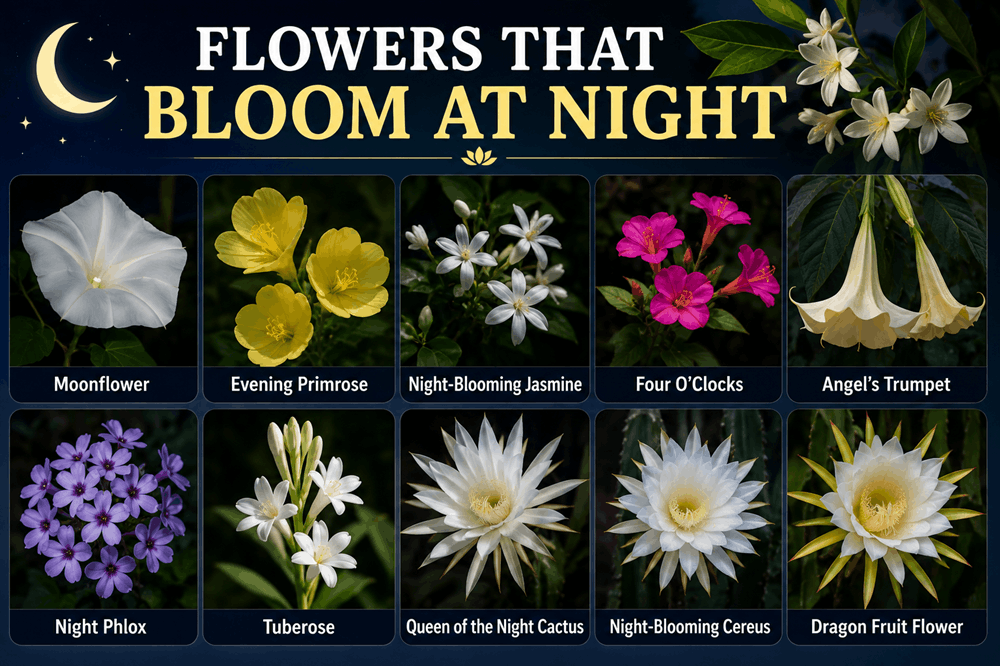
Flowers That Bloom at Night: Twenty Beautiful Moon Garden Favorites to Grow
Flowers that bloom at night include moonflower, evening primrose, night-blooming jasmine, four o’clocks, angel’s trumpet, night phlox, tuberose, and several remarkable cacti. These plants often open after sunset, release strong fragrances, or display pale flowers that are easy for nighttime pollinators to find. Together, they can turn an ordinary garden into a peaceful, fragrant space that becomes most interesting after dark.
Why Do Some Flowers Bloom at Night?
Night-blooming flowers have adapted to attract pollinators that are active after sunset. Moths, bats, beetles, and other nocturnal animals may carry pollen from one flower to another while searching for nectar.
Many night flowers share recognizable features:
- White, cream, pale yellow, or light pink petals
- Strong fragrance that becomes more noticeable after dark
- Long floral tubes that suit moths or bats
- Flowers that open near sunset and close after sunrise
- Large blooms that are easy to find in low light
Pale petals reflect moonlight and remain visible when darker flowers disappear into the background. Fragrance provides another signal, allowing pollinators to locate nectar even when visibility is limited.
Not every night-blooming flower follows the same schedule. Some open every evening for weeks, while others bloom for only one night each year. A few begin opening in late afternoon and remain attractive until the next morning.
1. Moonflower
Moonflower is one of the best-known night-blooming vines. Its large white flowers begin unfurling around sunset and remain open through much of the night.
The blooms have a sweet fragrance and can reach several inches across. Their bright white petals stand out clearly against the vine’s dark green leaves.
Moonflower grows quickly in warm weather and needs a trellis, fence, arch, or other support. It prefers full sun, fertile soil, and regular moisture.
The plant is related to morning glory, but its flowers open at the opposite time of day. All parts, especially the seeds, can be toxic if eaten, so grow it carefully around children and pets.
2. Evening Primrose
Evening primrose produces yellow, white, or pink flowers that often open rapidly near sunset. Some gardeners can watch the petals unfold over several minutes.
The flowers may remain open overnight and close as the morning becomes warmer. Their fragrance attracts evening moths and other pollinators.
Evening primrose grows best in full sun and well-drained soil. Some species behave as annuals or biennials, while others return as perennials.
The plant may reseed generously, so remove seed capsules if you do not want it spreading beyond its intended area.
3. Night-Blooming Jasmine
Night-blooming jasmine is grown for fragrance rather than showy flowers. Its small greenish-white blooms release an intense perfume after sunset.
The scent can travel across a patio or garden and may be overwhelming when the plant is placed near an open bedroom window. People sensitive to fragrance may prefer to grow it farther from doors and seating areas.
Night-blooming jasmine is a tropical shrub that prefers warmth, bright light, and well-drained soil. In cold climates, it can be grown in a container and moved indoors before frost.
Despite its common name, it is not a true jasmine. The plant can also be toxic if eaten.
4. Four O’Clocks
Four o’clocks receive their name from their habit of opening in late afternoon. The exact timing changes with temperature, sunlight, and weather, but the flowers often remain open well into the night.
Colors include pink, red, yellow, white, magenta, and striped or speckled combinations. A single plant may produce flowers in more than one color.
Four o’clocks grow from thick underground roots and thrive in warm, sunny conditions. They may return each year in mild climates and behave as annuals in colder areas.
The flowers have a pleasant fragrance, but the seeds and roots can be poisonous if swallowed.
5. Angel’s Trumpet
Angel’s trumpet produces enormous hanging flowers that may be white, cream, yellow, peach, pink, or orange. Many varieties release their strongest fragrance in the evening.
The plant grows as a large tropical shrub or small tree. It can become a dramatic focal point when planted near a patio, courtyard, or protected wall.
Angel’s trumpet needs warmth, regular feeding, and consistent moisture during active growth. In colder regions, it is often grown in a large container and moved to a frost-free location for winter.
Every part of the plant is highly poisonous. Wear gloves when pruning it, keep it away from children and pets, and never use it in homemade medicine.
6. Night Phlox
Night phlox is a compact plant with small star-shaped flowers that open during the evening. Its fragrance is often compared with honey, vanilla, or chocolate.
The flowers may be white, pink, purple, or burgundy, frequently with contrasting centers. Although each bloom is small, a group of plants can fill a seating area with fragrance.
Night phlox prefers full sun or light shade and soil that drains well. It works particularly well in containers, window boxes, and beds near patios where its evening scent can be appreciated.
7. Tuberose
Tuberose produces tall stems lined with waxy white flowers. The blossoms release a powerful, sweet fragrance that becomes especially noticeable after dark.
The plant grows from underground bulbs and prefers full sun, warm temperatures, and rich, well-drained soil. It may need staking if the flower stems become tall or top-heavy.
Tuberose is widely used in perfume and floral arrangements. A few stems can scent an entire room, so people who prefer subtle fragrances may want to plant it at some distance from seating areas.
8. Queen of the Night Cactus
Queen of the night cactus produces large white flowers that usually open after sunset and fade by morning. Each bloom may last only one night.
The flowers can be spectacular, with layers of narrow petals surrounding a pale center. Their short life makes the event feel especially memorable.
This cactus often has long, flattened stems and grows naturally in trees rather than in desert soil. It prefers bright indirect light, warmth, humidity, and a loose potting mixture with excellent drainage.
Mature plants may bloom only under suitable conditions, so patience is required.
9. Night-Blooming Cereus
Night-blooming cereus is a common name applied to several cactus species that produce large flowers after dark. Their white or cream blooms are often strongly fragrant and may remain open for just one evening.
Some species grow upright like desert cacti, while others have sprawling or climbing stems. The correct care depends on the particular plant.
Most need bright light, good drainage, and a cooler or drier rest period before flowering. Overwatering is a common cause of root damage.
10. Dragon Fruit Flower
Dragon fruit grows on climbing cactus stems and produces enormous white flowers that open at night. These blooms may be pollinated by moths, bats, or hand pollination in commercial growing systems.
The flowers are followed by colorful dragon fruit when pollination is successful. A plant may require another compatible variety to produce a good crop.
Dragon fruit cactus prefers warmth, strong light, and a sturdy support. It grows best in frost-free climates or large containers that can be protected during winter.
11. Chocolate Daisy
Chocolate daisy produces yellow flowers with maroon centers and a fragrance that resembles cocoa. The scent is often strongest during the morning, but the flowers may begin opening overnight.
This drought-tolerant perennial grows well in sunny, dry gardens and poor, well-drained soil. It is a useful choice for xeriscapes and regions with hot summers.
Removing faded flowers can encourage additional blooming and prevent excessive self-seeding.
12. Nottingham Catchfly
Nottingham catchfly produces white flowers with narrow, deeply divided petals. The blooms open in the evening and release a fragrance that attracts night-flying moths.
The plant is named for the sticky hairs found on its stems, which can trap small insects. It prefers sunny positions and dry, well-drained soil.
Its loose, informal appearance suits cottage gardens, gravel beds, and naturalistic plantings.
13. Night-Scented Stock
Night-scented stock has modest flowers, but its evening perfume makes it a favorite near paths, patios, and windows. The small blooms may be pale pink, lavender, or white.
The flowers often look partially closed during the day and become more fragrant after sunset. They work best when planted in groups rather than as isolated plants.
Night-scented stock prefers cool to mild weather, full sun, and well-drained soil. It may decline when summer heat becomes intense.
14. Nicotiana
Flowering tobacco, or nicotiana, produces tubular flowers in white, pink, red, green, purple, and cream. Many varieties release their strongest fragrance during the evening.
Tall white nicotianas are particularly effective in moon gardens because their flowers remain visible after dark. Compact modern varieties may have less fragrance, so check the plant description before buying.
Nicotiana prefers bright light and fertile soil with consistent moisture. The plant contains nicotine-related compounds and can be toxic if eaten.
15. Casablanca Lily
Casablanca lilies produce large white flowers with a rich fragrance that becomes especially noticeable in the evening. Their pale petals glow in low light, making them popular in moon gardens.
The plants prefer full sun or partial shade and well-drained soil. Their tall stems may need support in windy areas.
True lilies are extremely dangerous to cats. Even small amounts of petals, leaves, pollen, or vase water can cause fatal kidney failure. Cat households should not grow or display Casablanca lilies.
16. Evening Rain Lily
Rain lilies produce delicate, crocus-like flowers after periods of rainfall. Some species open most fully in late afternoon or evening.
Colors include white, pink, yellow, and lavender. The plants grow from small bulbs and form grassy clumps that work well along pathways, in containers, and at the front of borders.
Rain lilies prefer bright light and soil that drains well. They may remain dormant during dry periods and suddenly bloom after summer storms.
17. Sacred Datura
Sacred datura produces large white or pale lavender trumpet-shaped flowers that open in the evening. The flowers are followed by round, spiny seed capsules.
This plant tolerates heat and drought and often grows in dry landscapes. Its evening blooms attract large moths.
Every part of datura is highly poisonous. It should never be consumed or used in homemade preparations. Gardeners should handle the plant carefully and keep the seeds away from children and pets.
18. Night Gladiolus
Night gladiolus produces pale yellow or cream flowers with a strong spicy fragrance after sunset. It grows from underground corms and develops tall, narrow leaves.
The plant prefers full sun and well-drained soil. Its upright flower stems can add height to borders or large containers.
Night gladiolus may need winter protection in cold regions. It can also cause irritation or poisoning if eaten by pets.
19. Evening-Scented Orchid
Several orchids release stronger fragrances at night to attract moth pollinators. The specific scent may resemble citrus, vanilla, spice, or jasmine.
Night-fragrant orchids vary greatly in appearance and growing needs. Some require warm tropical conditions, while others prefer cooler nighttime temperatures.
Before buying one, identify the exact species and learn its requirements for light, humidity, watering, and potting material.
20. Brahma Kamal
Brahma Kamal is a name often used for a spectacular night-flowering cactus with large white blooms. The flowers commonly open late in the evening and fade by the following morning.
The plant is frequently confused with a high-altitude Himalayan flower that shares the same common name. The houseplant usually sold as Brahma Kamal is a tropical epiphytic cactus rather than an alpine plant.
It prefers bright indirect light, warmth, and a well-drained potting mixture. Mature plants may bloom only after several years of suitable care.
How to Design a Moon Garden
A moon garden is designed to be enjoyed during the evening. White and pale-colored flowers reflect available light, while fragrant plants create an atmosphere that does not depend entirely on visibility.
Choose a location near a patio, porch, walkway, or window so you can appreciate the plants after sunset. Combine low flowers, upright perennials, shrubs, and vines to create different heights.
Useful pale plants include:
- Moonflower
- White nicotiana
- Night-scented stock
- White petunias
- White phlox
- Silver-leaved foliage plants
- White roses
- Pale ornamental grasses
Reflective containers, light-colored gravel, and pale garden furniture can also increase visibility without requiring harsh lighting.
Choose Plants With Different Blooming Seasons
A garden built around one night-blooming plant may look impressive for only a short period. Select several plants that flower at different times.
Spring bulbs and pale perennials can begin the season. Nicotiana, tuberose, four o’clocks, moonflowers, and evening primrose can provide summer interest. Night-blooming cacti may flower unpredictably, adding occasional dramatic events.
Check the expected blooming season in your climate before planting. A flower that blooms in spring in one region may open during summer or fall somewhere else.
Use Fragrance Carefully
Strongly scented flowers are one of the main attractions of a night garden, but too many powerful fragrances together can become overwhelming.
Place the most fragrant plants at different distances from seating areas. Night-blooming jasmine and angel’s trumpet may be better near the edge of a patio rather than directly beside a chair or bedroom window.
People with asthma, migraines, allergies, or fragrance sensitivity may prefer lightly scented flowers and foliage plants.
Provide Habitat for Nighttime Pollinators
Night-blooming gardens can support moths, bats, beetles, and other nocturnal wildlife. Avoid broad-spectrum insecticides, especially while flowers are open.
Use outdoor lighting only where necessary. Bright lights can interfere with insect movement and make natural nighttime behavior more difficult.
Leave some shelter in the form of shrubs, trees, natural ground cover, and leaf litter. A living garden supports more wildlife than a space made entirely from flowers and hard landscaping.
Be Careful With Toxic Night Flowers
Several famous night-blooming plants are poisonous. Angel’s trumpet, datura, moonflower, four o’clocks, nicotiana, autumn-blooming lilies, and night-blooming jasmine all require caution.
Do not assume a plant is safe because it smells pleasant or is sold as an ornamental flower. Read the botanical name and check whether it is appropriate for a household with children or pets.
Wear gloves when handling highly toxic plants, wash your hands afterward, and never use unfamiliar flowers in food, tea, homemade medicine, or decoration where they may contact meals.
The Bottom Line
Flowers that bloom at night include moonflower, evening primrose, night-blooming jasmine, four o’clocks, angel’s trumpet, night phlox, tuberose, nicotiana, and several night-flowering cacti.
These plants rely on pale petals, strong fragrance, and nectar to attract moths, bats, and other nighttime pollinators. Some open every evening, while rare cactus flowers may last for only a single night.
The best night garden combines several blooming seasons, light-colored flowers, carefully placed fragrance, limited artificial lighting, and safe planting choices. With the right selection, the garden does not disappear after sunset. It becomes quieter, more fragrant, and entirely different from the space you see during the day.