Lit OG Strain: Genetics, Aroma, Effects, and THCa
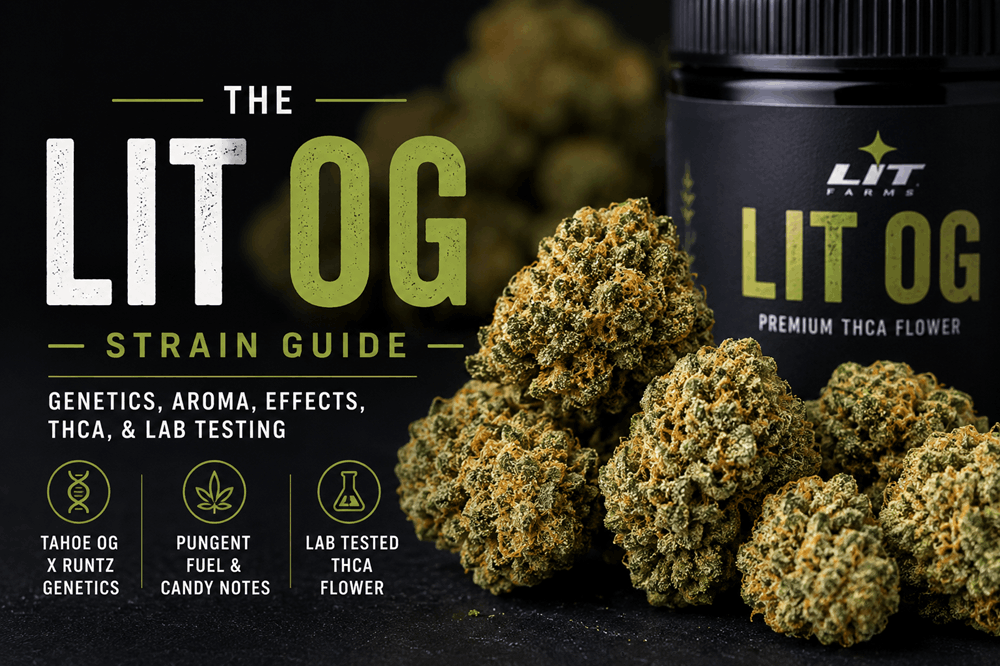
Lit OG is a cannabis hybrid developed by LIT Farms from Tahoe OG and Runtz genetics. Its breeder describes dense buds, prominent trichome coverage, and an aroma that combines pungent OG fuel with candy sweetness and an earthy finish.
The cultivar has also been marketed as “Lit OG THCa flower.” In that phrase, Lit OG identifies the cultivar, while THCa flower describes the cannabinoid profile or commercial category of a particular product.
A strain name cannot establish the potency, terpene content, purity, or effects of every batch carrying it. Those characteristics depend on the plant selection, cultivation conditions, harvest, storage, and laboratory results.
Important: This article is for general education only. It does not provide medical advice or recommend purchasing or using cannabis.
What Is the Lit OG Strain?
Lit OG—stylized as LIT OG by its breeder—is an in-house LIT Farms hybrid created by crossing Tahoe OG with Runtz.
The official LIT Farms description associates the cultivar with:
- Dense flower formations
- Heavy visible trichome coverage
- Pungent fuel and gas notes
- Candy-like sweetness
- An earthy finish
- A fast cerebral onset followed by a more settled, euphoric experience
These are breeder and seller descriptions, not independently verified specifications for every Lit OG product.
Genetics and Breeder
LIT Farms identifies the lineage as:
Tahoe OG × Runtz
The breeder presents the cross as combining Tahoe OG’s pungent fuel character with the sweeter candy qualities associated with Runtz. Those descriptions help explain the intended breeding direction, but they do not guarantee that every plant or harvested batch will express the same aroma or chemistry.
Plants grown from seed can produce different phenotypes. Cultivation, harvest timing, drying, curing, and storage can also affect the finished flower.
Is Lit OG an Indica or a Hybrid?
LIT Farms classifies Lit OG as a hybrid. Some sellers or strain databases may apply a more specific label, such as indica-leaning, but that classification should not be treated as a dependable forecast of its effects.
A peer-reviewed analysis of 89,923 commercial cannabis samples found that indica, sativa, and hybrid labels did not consistently match the products’ measured chemical composition. Products sharing a strain name could also vary between producers. Readers can explore the full PLOS ONE study on commercial cannabis labeling.
For a particular Lit OG product, its batch-specific laboratory report is more informative than a broad category label.
Appearance
The breeder specifically describes Lit OG as producing dense buds with heavy trichome coverage.
Appearance may still vary between harvests. More importantly, visual qualities alone cannot confirm:
- Cannabinoid potency
- Terpene concentrations
- Contaminant screening
- Product freshness
- Overall safety
A heavily frosted flower is not automatically stronger, cleaner, or more thoroughly tested than a less visually dramatic sample.
Aroma and Flavor
LIT Farms describes Lit OG as having a gas-and-candy profile: pungent OG fuel at the beginning, candy sweetness through the middle, and a warm earthy finish.
Its commonly reported sensory qualities can therefore be summarized as:
Aroma
- Fuel or gas
- Sweet candy
- Earth
Flavor
- Pungent OG
- Candy-like sweetness
- Warm earthiness
These descriptions are subjective. Different people may interpret the same aroma differently, and cultivation, curing, age, heat, oxygen, and storage can change a flower’s volatile compounds.
What Terpenes Are in Lit OG?
There is no universal terpene profile that applies to every Lit OG product.
Aroma descriptions such as fuel, candy, or earth cannot prove that a particular terpene is present or dominant. Only a laboratory report for the individual batch can show:
- Which terpenes were detected
- Their measured concentrations
- The reporting units
- The test date
- The laboratory’s detection limits
The current LIT Farms page itself tells readers to consult the batch Certificate of Analysis for the exact terpene breakdown.
Terpene results should also not be used to promise relaxation, energy, focus, sleep, or a medical benefit.
Reported Effects
LIT Farms describes Lit OG as having a fast and pronounced cerebral onset that settles into a euphoric, blissful baseline. This is a commercial breeder description rather than clinical evidence.
Individual responses can differ according to:
- Total THC exposure
- Amount used
- Consumption method
- Personal tolerance
- Medications or other substances
- Alcohol use
- Individual sensitivity
- The surrounding environment
THC-containing cannabis can impair reaction time, decision-making, coordination, and perception. It may also cause anxiety, confusion, dizziness, paranoia, or other unwanted reactions in some people.
Does Lit OG Have Medical Benefits?
Consumer reports do not prove that Lit OG treats pain, anxiety, insomnia, stress, or another health condition.
Retail flower is not a standardized medicine, and two products sold under the same cultivar name may differ in potency, terpene content, purity, and dose. Research involving a specific cannabinoid or pharmaceutical preparation cannot automatically be applied to any flower product labeled Lit OG.
Anyone considering cannabis for a health-related purpose should seek qualified professional guidance, particularly when taking medication, pregnant, breastfeeding, or managing a physical or mental health condition.
Lit OG, THCa, and Potency
What does “Lit OG THCa flower” mean?
“Lit OG THCa flower” generally refers to cannabis flower carrying the Lit OG cultivar name that contains a substantial concentration of tetrahydrocannabinolic acid, or THCa.
THCa is an acidic cannabinoid naturally found in cannabis. When exposed to heat, some THCa converts into delta-9 THC through decarboxylation. Temperature and heating time influence the conversion, which may be incomplete; prolonged heat can also cause cannabinoid loss or degradation.
A product containing little measured delta-9 THC before heating should not be assumed to be non-intoxicating if it contains substantial THCa and is smoked, vaporized, or otherwise heated.
Is THCa flower a separate kind of cannabis?
Not necessarily. “THCa flower” is commonly used as a commercial or regulatory description rather than a separate botanical classification.
A clearer distinction is:
- Cultivar: Lit OG
- Product: The harvested and packaged material
- Chemistry: Its measured cannabinoids and terpenes
- COA: The laboratory report for the tested sample
- Legal status: How current laws classify that product
The name Lit OG does not determine whether a product qualifies as hemp, marijuana, or another regulated category.
How potent is Lit OG?
Lit OG has no fixed THC or THCa percentage.
A percentage displayed by a breeder, retailer, or strain database ordinarily refers to a particular tested sample or harvest. To evaluate a specific product, check the COA that matches its batch.
Useful measurements may include:
- THCa
- Delta-9 THC
- CBDa and CBD
- CBGa and CBG
- Other reported cannabinoids
- Total or potential THC
Pay attention to whether results are reported as a percentage, milligrams per gram, dry-weight values, or another unit.
Total THC and USDA Hemp Testing
The current federal statutory definition of hemp refers to cannabis containing no more than 0.3% delta-9 THC on a dry-weight basis. USDA’s production-compliance procedure nevertheless accounts for the potential conversion of THCa when testing hemp crops.
For hemp grown under USDA, state, or tribal production plans, laboratories must use post-decarboxylation or another similarly reliable method that considers THCa’s potential conversion into THC. Results are reported on a dry-weight basis and include measurement uncertainty.
The commonly used calculation is:
Total THC ≈ delta-9 THC + (THCa × 0.877)
USDA’s hemp laboratory-testing guidelines concern crop-production compliance. They are not universal requirements for every finished retail product or commercial COA.
How to Read a Lit OG Certificate of Analysis
A Certificate of Analysis, or COA, reports findings for a tested sample. It does not prove that every product carrying the Lit OG name has the same composition.
Match the report to the product
Compare the COA with the package and look for matching information such as:
- Product name
- Batch or lot number
- Sample identifier
- Harvest or production date
- Package identifier
A report for a different harvest or product is not an adequate substitute.
Check the laboratory details
A useful report should identify:
- The testing laboratory
- The sample-received date
- The completion date
- The certificate or report number
- The methods used
- Relevant licensing or accreditation
When the laboratory offers an online verification system, use it to confirm that the report is authentic.
Review the cannabinoid results
Check the measured concentrations rather than relying only on a prominently displayed total.
The report should make clear:
- Which cannabinoids were tested
- Which were detected
- The reporting units
- Whether results use dry weight
- How total THC was calculated
Look beyond potency
A potency-only report does not show that a sample was screened for contaminants.
The current LIT Farms listing states that its Lit OG harvests are third-party tested for cannabinoids, terpenes, residual solvents, pesticides, and heavy metals, and it links to a batch COA. That statement applies to the seller’s current harvests; readers should still verify that the report matches the product they are evaluating.
Testing requirements vary by jurisdiction. California’s regulated cannabis program, for example, tests licensed batches for cannabinoids and terpenes, solvents, pesticides, heavy metals, microbes, mycotoxins, moisture, water activity, and foreign material. These are California requirements, not national standards for every cannabis or hemp product.
Understand common abbreviations
A COA may use:
- ND: Not detected
- LOD: Limit of detection
- LOQ: Limit of quantitation
- NT: Not tested
- Pass/Fail: Whether the sample met the applicable limit
“Not detected” usually means the substance was not found above the method’s detection threshold. It does not necessarily prove that absolutely none was present.
Why Lit OG Batches Can Differ
Products sharing the Lit OG name can vary because of:
- Phenotype selection
- Seed-grown versus clone-grown plants
- Cultivation conditions
- Harvest timing
- Drying and curing
- Age and storage
- Laboratory methods
- Inconsistent naming
This is why a recent COA linked to the packaged batch is more useful than an old potency number or a generalized strain-directory profile.
Lit OG and Its Parent Cultivars
LIT Farms presents Lit OG as combining qualities associated with Tahoe OG and Runtz.
Tahoe OG supplies the reported pungent fuel side of the cross, while Runtz supplies its candy sweetness. These are breeder descriptions of the intended aroma profile—not proof that every batch will reproduce those traits in the same proportions.
Parentage also cannot reliably predict an individual consumer’s response.
Lit OG Versus OG Runtz
Lit OG should not be confused with OG Runtz.
LIT Farms identifies:
- Lit OG: Tahoe OG × Runtz
- OG Runtz: OG Kush × Runtz
They share Runtz ancestry but are presented as separate cultivars with different OG parents.
Similar names do not establish identical genetics, chemistry, or effects. When researching a strain, confirm the complete name, breeder, parentage, producer, and matching laboratory report.
Safety Considerations
THCa-rich flower can produce intoxicating THC when heated.
Cannabis can slow reaction time, impair coordination and decision-making, and distort perception. Combining cannabis with alcohol or other impairing substances may increase impairment.
Basic precautions include:
- Do not drive or operate machinery while impaired.
- Avoid combining cannabis with alcohol or other impairing substances.
- Keep cannabis products away from children and pets.
- Be cautious with products lacking verifiable batch testing.
- Seek professional guidance during pregnancy, breastfeeding, medication use, or treatment for a health condition.
For a possible poisoning in the United States, use webPOISONCONTROL or call 1-800-222-1222. Call 911 immediately if someone collapses, has a seizure, has trouble breathing, or cannot be awakened.
Is Lit OG Legal?
The name Lit OG does not determine whether a particular product is legal. Its status depends on its cannabinoid content and the federal, state, tribal, and local rules applying where it is produced, sold, possessed, or used.
As of July 2026, the federal definition of hemp still refers to cannabis and its derivatives containing no more than 0.3% delta-9 THC on a dry-weight basis.
A federal amendment enacted on November 12, 2025, is scheduled to take effect 365 days later, on November 12, 2026. The amended definition uses total tetrahydrocannabinols, expressly includes THCa, and adds exclusions affecting certain hemp-derived cannabinoid products.
State laws may already apply total-THC standards or impose broader restrictions. Labels such as “hemp-derived,” “Farm Bill compliant,” or “federally legal” do not establish legality in every jurisdiction.
Because these rules change, readers should check current laws where they live rather than relying on an older article or product label.
Frequently Asked Questions
What are the genetics of Lit OG?
LIT Farms identifies Lit OG as Tahoe OG crossed with Runtz.
Is Lit OG an indica or a hybrid?
The breeder classifies it as a hybrid. More specific indica- or sativa-leaning labels should not be treated as reliable predictions of its chemistry or effects.
What does Lit OG smell like?
LIT Farms describes pungent OG fuel, candy sweetness, and a warm earthy finish. Individual batches may differ.
What terpenes are in Lit OG?
There is no universal terpene profile. Check the laboratory report for the specific batch to see which terpenes were measured.
How potent is Lit OG?
There is no fixed potency for the cultivar. The relevant THCa, delta-9 THC, and total-THC figures are those shown on the COA matching the packaged batch.
Is Lit OG the same as OG Runtz?
No. LIT Farms lists Lit OG as Tahoe OG × Runtz and OG Runtz as OG Kush × Runtz.
The Bottom Line
Lit OG is a LIT Farms hybrid created from Tahoe OG and Runtz genetics. Its breeder describes dense, trichome-covered flower with pungent fuel, candy sweetness, and an earthy finish, along with a fast cerebral onset that settles into euphoria.
Those details provide useful background, but they do not define every product carrying the name.
A matching Certificate of Analysis is the best source for evaluating the potency, terpene content, and testing scope of a particular batch. The cultivar name alone cannot guarantee its chemistry, effects, safety, or legal status.